The short answer
The King James Bible, or King James Version (KJV), is the English translation of the Bible that King James I approved at the Hampton Court Conference in 1604 and that was first printed in London in 1611. About 47 scholars and clergymen, working in six companies at Westminster, Oxford and Cambridge, revised the Bishops’ Bible against the Hebrew and Greek. Most KJV Bibles today follow the Oxford edition of 1769, which standardized the spelling.
What is the King James Bible?
The King James Bible, also called the King James Version (KJV) or the Authorized Version, is an English translation of the whole Bible made for the Church of England and first printed in London in 1611. Its title page says it was “Newly Translated out of the Originall tongues” and “with the former Translations diligently compared and revised.” That sums up the method: a careful revision of earlier English Bibles, worked through line by line against the Hebrew and Greek.
Four centuries later it is still printed, read and quoted. This page explains who made it, when and why; How many mistakes are in the King James Bible? covers its misprints and corrections, and Why is the KJV controversial? the debates.
| Fact | King James Bible |
|---|---|
| Commissioned | 1604, after the Hampton Court Conference, with the approval of King James I |
| Translators | About 47 scholars and clergymen (54 were appointed) |
| Where they worked | Six companies: two each at Westminster, Oxford and Cambridge |
| Base text | The Bishops’ Bible (1568), checked against the Hebrew, Aramaic and Greek and against earlier English Bibles |
| First printed | 1611, in London, by Robert Barker, the King’s Printer |
| Contents in 1611 | Old Testament, Apocrypha and New Testament |
| Text in most printings today | The 1769 Oxford edition of Benjamin Blayney |
| Church | Church of England (Protestant) |
Hampton Court, 1604: the king’s commission
When James VI of Scotland also became King James I of England in 1603, the Puritan wing of the Church of England hoped he would carry the Reformation further. On his journey south he was handed a petition said to bear the signatures of a thousand ministers, and in January 1604 he called bishops and Puritan leaders to a three-day conference at Hampton Court Palace.
Most Puritan requests were turned down. But midway through the conference John Rainolds (also spelled Reynolds), president of Corpus Christi College, Oxford, asked the king to approve a new English translation of the whole Bible, and James agreed. Cambridge University Library notes that the idea met little warmth at first, yet it was the one proposal from Hampton Court that produced a lasting result.
Organizing the work fell to Richard Bancroft, then Bishop of London, who became Archbishop of Canterbury in 1604. He recruited the scholars, sent out the rules and found church posts to support the translators, since neither the king nor Parliament paid for the project. James clearly wanted the new Bible, but he took no part in the translating itself.
The translators, their rules and their sources
No complete list of everyone who worked on the translation survives. Fifty-four scholars were appointed, and researchers at the Folger Shakespeare Library use an approximate figure of 47 translators. They were organized in six companies, two each at Westminster, Oxford and Cambridge, and each company took its own portion of the Bible. Lancelot Andrewes led the first Westminster company, one Cambridge company translated the Old Testament from 1 Chronicles to Ecclesiastes, and another was assigned part of the Apocrypha.
The project ran under 15 rules. The Bishops’ Bible of 1568 was the base text, and each translator received an unbound copy of its 1602 edition; Tyndale’s, Matthew’s and Coverdale’s Bibles, the Great Bible and the Geneva Bible were to be used to correct it where needed. Marginal notes were allowed only to explain Hebrew or Greek words. Drafts went round the companies, a general meeting reviewed them in 1609 and 1610, and Thomas Bilson, bishop of Winchester, and Miles Smith, bishop of Gloucester, did the final editing.
Behind the English stood the original languages: the Hebrew of the Old Testament, including the chapters of Daniel and Ezra written in Aramaic, and the Greek of the New Testament. The translators also kept much of the English Bibles before them. Cambridge University Library cites a recent calculation that 83 percent of the King James text comes directly from William Tyndale’s New Testament of 1534 (that is, in the New Testament, the part his book covers), and the opening of John’s Gospel passed into the King James Bible almost unaltered from Tyndale. The Catholic Rheims New Testament of 1582 was not an official source, but the translators undoubtedly knew it.
In their preface, “The Translators to the Reader,” they described the aim in their own words: not to make a bad translation good, “but to make a good one better, or out of many good ones, one principal good one.”
How the rules shaped particular words, and the wider debate over royal influence, are covered in Why is the KJV controversial?
1611: the first printing
The finished Bible was printed in London in 1611 by Robert Barker, the King’s Printer. Because it was technically a revision rather than a new work, it was never entered in the Stationers’ Register, so its exact publication date is unknown; scholars estimate the first edition at roughly 500 to 1,000 copies. Barker received no payment from the king, Parliament or the church; Cambridge University Library estimates that he spent £3,000 on the job.
The book was printed in a large format so it could be read aloud in churches, and its title page carries the words “Appointed to be read in Churches.” Besides the Old and New Testaments it contained the Apocrypha, along with church calendars and other material for services. Our King James editions are the New Testament and the Torah; we do not print a complete Bible or the Apocrypha.
The first printing was full of misprints; a slip at Ruth 3:15 gave its two issues the nicknames “He Bible” and “She Bible” (see How many mistakes are in the King James Bible?).
From 1611 to the 1769 standard text
Printers and editors kept correcting the text for more than 150 years. Cambridge produced revised editions in 1629 and 1638, Thomas Paris edited another at Cambridge in 1762, and in 1769 Benjamin Blayney completed an Oxford edition that standardized the spelling. Blayney’s text is the one that has been reprinted ever since, which is why most King James Bibles today follow the 1769 text. It is also the text our King James editions print.
The name “Authorized Version” suggests an official decree, but Cambridge University Library notes that no record survives of the translation ever being authorized, and its 2011 exhibition states that the King James Bible was never formally authorized. What the title page claims is that it was made “by his Majesties Special Commandment” and “Appointed to be read in Churches.”
Backed by the King’s Printer’s monopoly, the new translation quickly replaced the Bishops’ Bible and, more slowly, the Geneva Bible, and it reigned unchallenged until the 1880s. Today it is in the public domain in the United States; the position in the United Kingdom is different, as Who owns the King James Bible rights? explains.
Protestant or Catholic? Who uses it today
The King James Bible is a Protestant Bible. It was made for the Church of England by Anglican and Puritan scholars, and according to Bible Gateway it quickly became the standard Bible for English-speaking Protestants.
English Catholics of the time had their own translation from the Latin Vulgate, made by exiles at the English College in Rheims and later Douai: the Rheims New Testament of 1582 and the Douai Old Testament of 1609, which came too late to be used for the King James Bible. Later revised by Bishop Richard Challoner, the Douay–Rheims remained the standard Catholic English translation until the twentieth century.
The KJV is still widely read. On the ECPA’s Bible translations bestseller list dated October 2026 it ranked third, after the New International Version and the English Standard Version (see the most popular Bible translations). The Church of Jesus Christ of Latter-day Saints uses the King James Version as its official English Bible, in a Church edition first issued in 1979 with its own chapter headings, footnotes and cross-references. For the view that the KJV is the only English Bible Christians should use, and its critics, see Is the KJV the only true Bible?
Why the King James Bible matters
Along with the works of Shakespeare, the King James Bible is often cited as one of the greatest influences on modern English, as Brigham Young University’s library puts it. Its rhythms run through writers and speakers as different as Herman Melville, John Steinbeck and Abraham Lincoln. Lines such as “Let there be light: and there was light” (Genesis 1:3) and “Ye are the salt of the earth” (Matthew 5:13) are widely known in its wording.
Its gift to everyday speech is real but easy to overstate. The linguist David Crystal counted 257 English idioms that come from the King James Bible, such as “how are the mighty fallen,” yet found that most did not begin there: they were already in Tyndale, Wycliffe or the Bishops’ Bible. By his count only 18 are stylistically unique to the KJV. What it did, he argues, was popularize them, and no other literary source has matched it for the number of influential expressions it contains.
See the timeless KJV for why many readers still choose it, NIV vs KJV for a comparison with a modern translation, and What is the World English Bible? for the New Testament in present-day English.
From our shelf
Read the King James New Testament
We print the King James Version (the standard 1769 text), the World English Bible, the Lutherbibel 1912 and the Danish 1871/1907. In the United Kingdom, Jersey, Guernsey and the Isle of Man our books come in the World English Bible. We do not print a complete Bible, and not the NIV, ESV or other modern translations; for those, a bookshop or your church is the place.
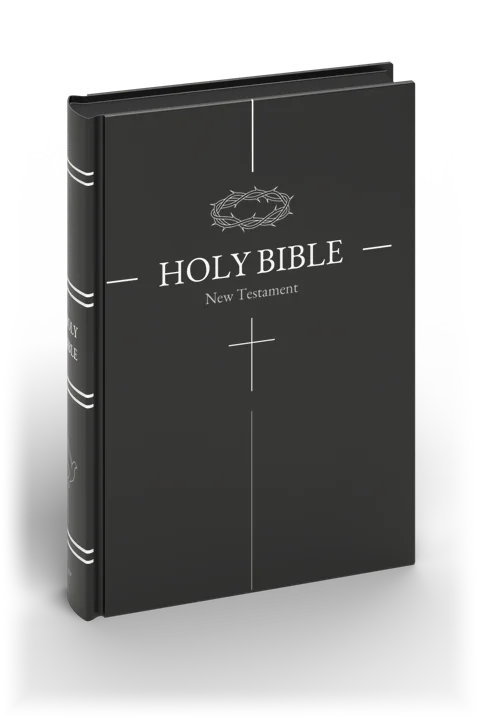
The Black Edition, King James Version
The complete New Testament in the KJV (the standard 1769 text), white text on black pages, the words of Jesus in red. A5, 392 pages.
Softcover $60 · Hardcover $80 · eBook $10 USD
See the KJV Black Edition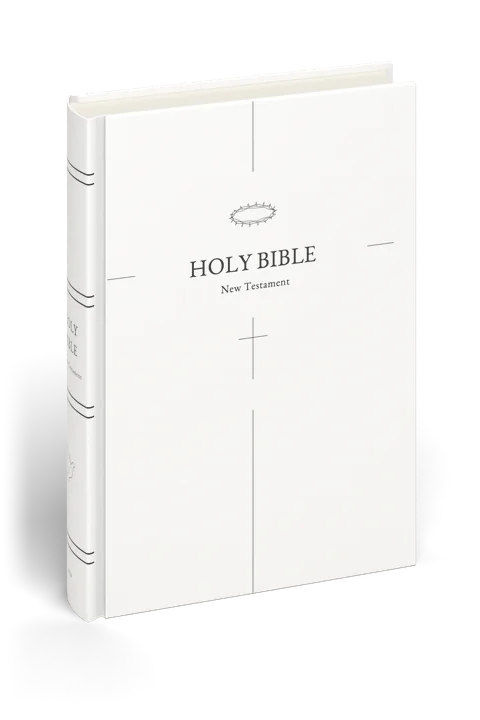
The White Edition New Testament
The same New Testament in classic black type on white pages, the words of Jesus in red. KJV, WEB, German or Danish.
Softcover $60 · Hardcover $80 · eBook $10 USD
See the White Edition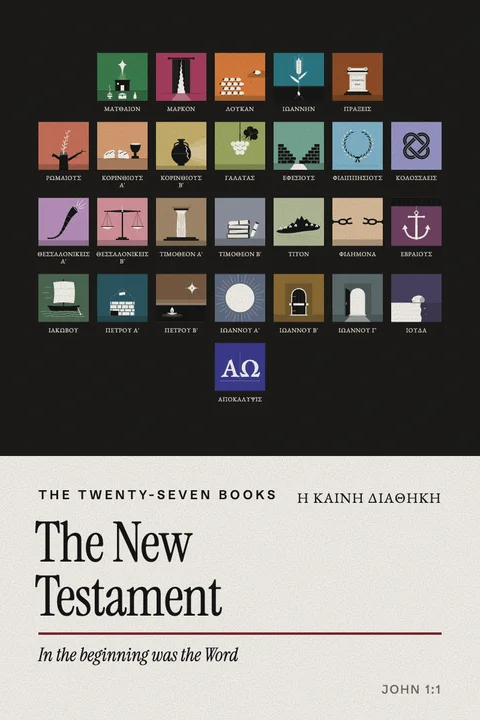
The illustrated New Testament, one volume
All 27 books, each opening with its own cover, 28 full-page illustrations, the words of Jesus in red. King James Version or World English Bible. 6 × 9 in.
Softcover $75 · Hardcover $90 · eBook $10 USD
See the New Testament
Prices in USD, tax included; shipping is calculated at checkout and free over $80. Printed books are printed to order; eBooks are a PDF and an ePub, emailed after payment.
Questions
More questions people ask
Is the King James Bible Protestant or Catholic?
Protestant. It was translated for the Church of England by Anglican and Puritan scholars and first printed in 1611. English-speaking Catholics of the time used the Douay–Rheims translation from the Latin Vulgate, with the New Testament printed in 1582 and the Old Testament in 1609.
Which religion uses the King James Bible?
Mainly Protestant Christianity, for which it quickly became the standard English Bible. The Church of Jesus Christ of Latter-day Saints also uses it as its official English Bible, in its own edition first issued in 1979.
Is the KJV a translation of the Bible?
Yes. Its 1611 title page says it was newly translated out of the original tongues and compared with the former translations. Technically it was a revision of the Bishops’ Bible of 1568, checked against the Hebrew, Aramaic and Greek.
How is the KJV Bible different?
It keeps the English of the early 1600s, with words such as thee, thou and hath, in the spelling standardized in 1769. Modern translations use present-day English and in places read differently; our NIV vs KJV page compares the two in detail.
Do Christians read the KJV?
Yes, many do. On the ECPA’s list of best-selling Bible translations dated October 2026 it ranked third, after the New International Version and the English Standard Version.
Sources
- lib.cam.ac.uk: 1603 petition of a thousand ministers; three-day conference in early 1604; new translation proposed by Puritans, met little warmth, the only tangible result
- folger.edu: About 47 translators, no definitive list; met at Oxford, Cambridge, Westminster Abbey; 1602 Bishops’ Bible copies; Rainolds’ request; 500–1,000 copies
- bridwell.omeka.net (SMU): Reynolds of Corpus Christi College, Oxford, urged a new translation; 47 Anglican and Puritan translators; Bishops’ Bible kept unless Hebrew or Greek required
- bridwell.omeka.net (SMU): KJV originated with the Hampton Court conference in January 1604; a committee of fifty-four scholars appointed; London: Robert Barker, 1611
- lib.byu.edu: Bancroft, Bishop of London, oversaw the work; neither King nor Parliament paid; six companies; Bishops’ Bible base; notes only to explain Hebrew or Greek
- lib.byu.edu: Hampton Court conference of January 1604 between Church of England leaders and Puritans; James welcomed the suggestion of a new translation
- lib.byu.edu: 1611 printed large to be read aloud in churches; contains OT, NT and Apocrypha plus calendars; Barker unpaid by King, Parliament or Church; He/She Bible
- lib.byu.edu: With Shakespeare, the KJB is cited as one of the greatest influences on modern English; influence on Melville, Steinbeck and Lincoln
- lib.byu.edu: The LDS Church still uses the King James Bible; its current LDS edition was first issued in 1979
- lib.cam.ac.uk: Six companies (2 each place); Bishops’ base, other Bibles to correct; Bilson, Smith; 83% from Tyndale 1534; Rheims known; not in Stationers’ Register; £3,000
- lib.cam.ac.uk: Bancroft took the lead and sent rules in his own hand; Andrewes led first Westminster company; Cambridge: 1 Chronicles–Ecclesiastes, part of the Apocrypha
- lib.cam.ac.uk: No record survives of it being authorised; never formally authorised; supplanted the Bishops’ Bible and, more slowly, Geneva; unchallenged until the 1880s
- lib.cam.ac.uk: Rheims New Testament (1582) made from the Vulgate by Catholic exiles at the English College; Douai Old Testament published in 1609
- neh.gov: The translators worked in committees and laid down 15 rules; King James never lifted a quill toward the effort
- ccel.org: 1611 title page: Newly Translated out of the Originall tongues; Appointed to be read in Churches; Robert Barker; revisions 1629, 1638, 1762, 1769
- ccel.org: “The Translators to the Reader” (1611): the aim was “to make a good one better, or out of many good ones, one principal good one”
- biola.edu: Daniel 2:4b–7 is in Aramaic, the rest in Hebrew; Daniel’s Aramaic is like the Aramaic portions of Ezra
- timeshighereducation.com: Blayney’s 1769 Oxford edition is the edition reprinted ever since; KJV spelling was standardized in 1769
- biblegateway.com: 1604 new translation begun, finished 1611; the Authorized Version quickly became the standard for English-speaking Protestants; public domain in the US
- churchofjesuschrist.org: KJV is the official English Bible of The Church of Jesus Christ of Latter-day Saints; its edition since 1979 has chapter headings, footnotes, cross-references
- readgoodbooks.com (ECPA): ECPA Bible Translations list dated October 2026: 1 NIV, 2 ESV, 3 King James Version
- bibleinterp.arizona.edu: David Crystal found 257 KJB idioms; most do not originate in the KJV; only 18 stylistically unique; the KJV popularized them; e.g. “how are the mighty fallen”