The short answer
Neither is better for everyone. The KJV (1611) is a word-for-word translation of the Textus Receptus in traditional English, while the NIV (1978, updated 2011) balances accuracy with modern readability and follows older manuscripts, so it moves a few KJV verses into footnotes. Choose the KJV for its historic text and wording; choose the NIV for easier everyday reading.
NIV vs KJV at a glance
The King James Version and the New International Version are the two best-known English Bibles, and they were made for different moments. The KJV was produced under royal commission and published in 1611. The NIV was begun in 1965 by evangelical scholars who chose to make a fresh translation from the original languages rather than update an older one.
| King James Version (KJV) | New International Version (NIV) | |
|---|---|---|
| First published | 1611; most printings follow the 1769 standard text | New Testament 1973, full Bible 1978; updated 1984 and 2011 |
| Translators | 47 scholars, commissioned by King James VI and I | Committee on Bible Translation; more than 100 scholars on the first edition |
| Old Testament text | Hebrew Masoretic Text | Masoretic Text (latest Biblia Hebraica), occasionally the Dead Sea Scrolls or ancient versions, with footnotes |
| New Testament text | Textus Receptus (printed Greek editions from 1516 onward) | Eclectic text based on the Nestle-Aland / UBS editions |
| Approach | Word-for-word (formal equivalence) | Balances transparency to the original with clarity |
| Reading level | Grade 12 (Bible Gateway) | Grade 7 (Bible Gateway); grade 8 (publisher) |
| Copyright | Public domain in most countries; Crown rights in the UK | Copyrighted (1973, 1978, 1984, 2011) |
| ECPA sales rank, October 2026 | 3 | 1 |
Different source texts: Textus Receptus vs critical text
The biggest difference lies less in the English than in the Greek behind it. The KJV New Testament translates the Textus Receptus, the printed Greek editions that began with Erasmus in 1516 and were later revised by Stephanus and Beza. Erasmus worked mainly from a few late medieval manuscripts. In the Old Testament, the KJV follows the Hebrew Masoretic Text.
The NIV New Testament follows an eclectic Greek text based on the latest Nestle-Aland and United Bible Societies editions, which give more weight to the oldest surviving manuscripts, such as Codex Sinaiticus and Codex Vaticanus. Its Old Testament uses the Masoretic Text in the latest Biblia Hebraica, occasionally following the Dead Sea Scrolls or other ancient witnesses where the Hebrew seems doubtful, usually with a footnote.
Most textual scholars today prefer the critical text. Those who favor the KJV argue that the received text reflects the Greek the churches used through the centuries. The two traditions agree on most of the New Testament; the NKJV preface estimates the shared portion at about 85 percent.
Verses the NIV places in footnotes
Because of that textual choice, a few verses found in the KJV appear in the NIV only as footnotes, with the verse number kept in brackets. The NIV does not hide them: the note prints the wording and says that some manuscripts include it.
Acts 8:37. In the KJV, the baptism of the Ethiopian official includes this exchange: “And Philip said, If thou believest with all thine heart, thou mayest. And he answered and said, I believe that Jesus Christ is the Son of God.” The NIV moves from verse 36 to verse 38 and gives the exchange in a footnote.
1 John 5:7. The KJV reads: “For there are three that bear record in heaven, the Father, the Word, and the Holy Ghost: and these three are one.” The NIV's verses 7 and 8 speak only of the three that testify, and its footnote explains that the longer wording comes from late manuscripts of the Latin Vulgate and is not found in any Greek manuscript before the fourteenth century. This passage, known as the Johannine Comma, is the best-known textual difference between the two Bibles.
Other verses the NIV keeps in footnotes include Matthew 17:21, Matthew 18:11, John 5:4 and Romans 16:24. Two longer passages, Mark 16:9-20 and John 7:53-8:11, stay in the NIV text but are set off by a note saying the earliest manuscripts do not include them.
Reading level and language
Bible Gateway's translation guide rates the KJV at a twelfth-grade reading level and the NIV at about seventh grade; the NIV's publisher puts it at eighth grade. The gap comes less from sentence length than from vocabulary: thee and thou, verb endings such as -eth, and words whose meaning has shifted since 1611.
Two examples show the problem. In 1 Thessalonians 4:15 the KJV says the living “shall not prevent them which are asleep”, where prevent has its older sense of coming before. In 2 Thessalonians 2:7, “he who now letteth will let” uses let in its old sense of hindering. Modern translations, the NIV among them, put these ideas into current words, so the reader needs no glossary.
The NIV also works to keep its English current. For its 2011 update, the translators commissioned a study of gender language drawing on the Collins Bank of English, a database of more than 4.4 billion words of contemporary English.
Translation philosophy
The KJV is a formal, word-for-word translation that stays close to the structure of the original. The NIV's committee chose a middle path, balancing transparency to the original with clarity of meaning. In practice the NIV more often restructures a sentence or renders an idiom by its sense, while the KJV more often keeps the original wording and image and leaves the interpretation to the reader.
Which should you choose?
The right choice depends on what you value most in a Bible you will use every day.
- Choose the KJV if you value the traditional Textus Receptus, want the wording of the historic English Bible, or memorize Scripture in its classic form.
- Choose the NIV if you want to read long passages easily, are new to the Bible, or want a translation based on the oldest manuscripts in today's English.
- Choose the NKJV if you want the KJV's Greek text and much of its style in updated English.
- Use both side by side for study: where they differ, the footnotes usually explain why.
From our shelf
The translations we print
We print four public-domain texts: the King James Version, the World English Bible, the Lutherbibel 1912 and the Danish 1871/1907. We do not print a complete Bible, and not the NIV, ESV or other modern translations; for those, a bookshop or your church is the place.
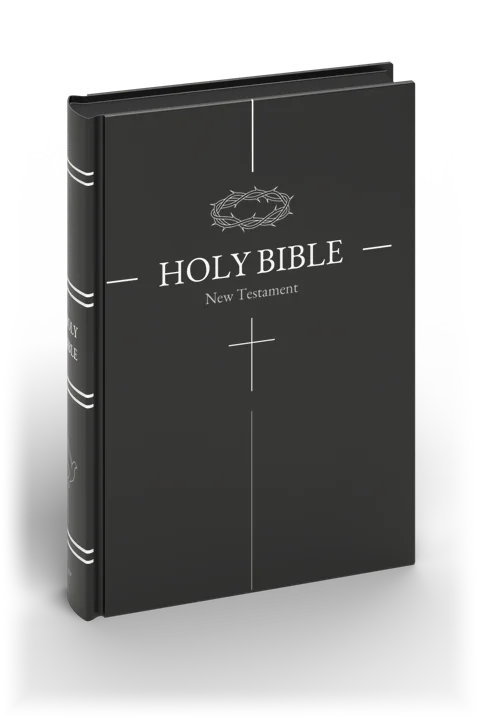
The Black Edition, King James Version
The complete New Testament in the KJV (the standard 1769 text), white text on black pages, the words of Jesus in red. A5, 392 pages.
Softcover $60 · Hardcover $80 · eBook $10 USD
See the KJV Black Edition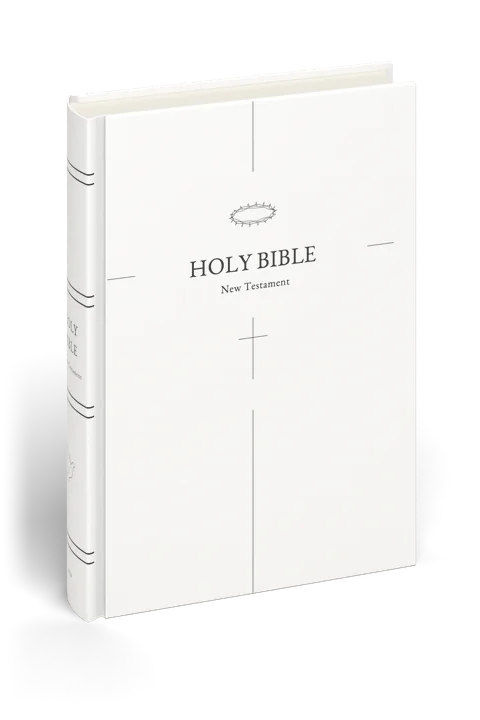
The White Edition New Testament
The same New Testament in classic black type on white pages, the words of Jesus in red. KJV, WEB, German or Danish.
Softcover $60 · Hardcover $80 · eBook $10 USD
See the White Edition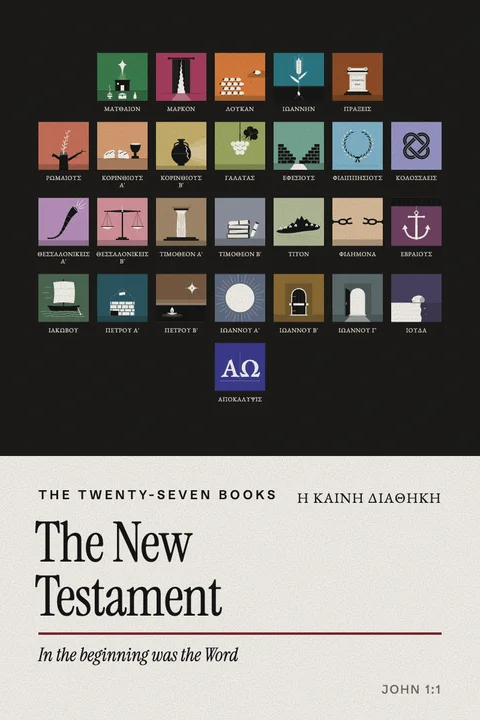
The illustrated New Testament, one volume
All 27 books, each opening with its own cover, 28 full-page illustrations, the words of Jesus in red. King James Version or World English Bible. 6 × 9 in.
Softcover $75 · Hardcover $90 · eBook $10 USD
See the New Testament
Prices in USD, tax included; shipping is calculated at checkout and free over $80. Printed books are printed to order; eBooks are a PDF and an ePub, emailed after payment.
Questions
More questions people ask
Is KJV harder to read than NIV?
Yes, for most modern readers. Bible Gateway rates the KJV at a twelfth-grade reading level and the NIV at about seventh grade (its publisher says eighth). The difficulty is mainly older vocabulary and grammar, such as thee and thou, and words like prevent and let whose meanings have changed since 1611.
Which Bible translation is closest to the King James?
The New King James Version (1982). Its preface presents it as a continuation of the King James translators' work: it keeps the same Greek New Testament text, the Textus Receptus, and much of the KJV's style, while updating archaic pronouns, verb forms and vocabulary.
Did the NIV remove verses from the Bible?
No verses are deleted. A small number of verses found in later manuscripts are printed in the NIV's footnotes instead of the main text, with the verse numbers kept in brackets, because the translators judged that they were not part of the original text.
Is the NIV a revision of the KJV?
No. When work on the NIV began in 1965, the scholars decided to start a new translation from the original languages instead of updating an existing one such as the KJV.
Sources
- thenivbible.com: NIV history: 1965 meeting; chose to start from scratch rather than update an existing translation such as the KJV; first edition 1978 by more than 100 scholars
- biblegateway.com: NIV copyright years 1973, 1978, 1984, 2011
- thenivbible.com: NIV first edition 1978 by more than 100 scholars; CBT of 15; 2011 update gender-language study using Collins Bank of English (4.4 billion words); balancing tran…
- biblia.com: NIV 2011 preface: Masoretic Text in latest Biblia Hebraica; Dead Sea Scrolls etc. occasionally followed with footnotes; eclectic Greek text based on Nestle-Alan…
- thenivbible.com: NIV publisher: 8th-grade reading level
- en.wikipedia.org: KJV 1611, 47 translators, commissioned by James VI and I after the 1604 Hampton Court Conference; Textus Receptus; Masoretic Text; 1769 standard text; Crown cop…
- en.wikipedia.org: Textus Receptus: Erasmus 1516, Stephanus, Beza; late manuscripts; critical texts rely on Sinaiticus and Vaticanus; most textual critics consider TR inferior
- bible-researcher.com: NKJV preface: about 85 percent of NT text shared; Textus Receptus base; continuation of KJV translators' work; updates archaic pronouns and verb forms; 1982
- biblegateway.com: NIV puts Acts 8:37 in a footnote; 1 John 5:7 footnote: late Vulgate manuscripts, not in any Greek manuscript before the 14th century; KJV wording of both verses
- biblegateway.com: NIV footnotes Matthew 17:21, Matthew 18:11, John 5:4, Romans 16:24; notes before Mark 16:9-20 and John 7:53-8:11
- biblegateway.com: Reading levels: KJV 12, NIV 7
- en.wiktionary.org: Obsolete sense of prevent: to come before, precede (1 Thessalonians 4:15 KJV)
- en.wiktionary.org: Archaic sense of let: to hinder (2 Thessalonians 2:7 KJV)
- readgoodbooks.com: ECPA October 2026: NIV 1, KJV 3