The short answer
There is no single agreed number. The famous “mistakes” are mostly printers’ errors in particular early printings, such as the 1631 “Wicked Bible” that left “not” out of the seventh commandment, together with hundreds of small corrections to misprints, spelling and italics made between 1611 and the standard Oxford text of 1769. A few translation choices, such as “unicorn” and “Easter,” are disputed, and defenders of the KJV explain them differently than critics do.
Why there is no single count
People who ask how many mistakes are in the King James Bible usually mean one of three things: misprints in particular printings, the many small differences between the first printing of 1611 and the text sold today, or translation choices that critics dispute. A fourth question, which Greek wording to translate, concerns the text behind the KJV rather than its translators or printers.
No authoritative manuscript survives to settle doubtful readings: the translators’ copy, reportedly still in existence in 1655, is said to have perished in the Great Fire of London. Scholars who have counted have counted different things: Cambridge University Library notes that its 1629 edition made at least 493 changes, while David Norton’s modern study lists and analyzes about 400 variants in the early printings. These figures measure different kinds of change and cannot be added into one total.
Famous misprints in particular printings
Early Bibles were set by hand, letter by letter, and errors crept in easily. Cambridge University Library describes the King’s Printer, Robert Barker, as a disorganized workman who introduced many typographical errors, and his first edition of 1611 as riddled with misprints, including three lines of Exodus printed twice. Even the translators’ careful italics, which mark words added to make the sense clear, became muddled. Later printings produced slips famous enough to earn nicknames.
| Nickname | Printing | Verse | What it said |
|---|---|---|---|
| He Bible / She Bible | 1611 first issue and its 1613 reissue | Ruth 3:15 | The 1611 issue reads “he went”; the reissue reads “she went” |
| Printers’ Bible | A few copies of a 1612 edition | Psalm 119:161 | “Printers have persecuted me without a cause” for “Princes” |
| Judas Bible | 1613 folio, London | Matthew 26:36 | “Judas” for “Jesus” |
| Wicked Bible | 1631, London (Robert Barker and partner) | Exodus 20:14 | “Thou shalt commit adultery,” with “not” left out |
| Unrighteous Bible | 1653, London (John Field) | 1 Corinthians 6:9 | “the unrighteous shall inherit the kingdom of God,” again without “not” |
| Vinegar Bible | 1717, Oxford (John Baskett) | Page heading in Luke | “Parable of the vinegar” for “vineyard” |
| Killer Bible | 1795, London | Mark 7:27 | “Let the children first be killed” for “filled” |
The He Bible and She Bible are the two issues of the first edition. The 1611 printing reads “he went” at Ruth 3:15 where, as Brigham Young University’s library puts it, the context calls for “she went”; the 1613 reissue, printed from reset type, corrected it. Not every translation agrees: the World English Bible reads “then he went into the city.” The standard 1769 text that our KJV editions follow reads “she went into the city.”
The standard text also reads “Princes have persecuted me without a cause” at Psalm 119:161, and our KJV New Testament reads “Then cometh Jesus with them unto a place called Gethsemane” at Matthew 26:36 and “Let the children first be filled” at Mark 7:27.
The Wicked Bible of 1631
The most notorious misprint appeared in a small 1631 edition printed by Robert Barker and his partner. The seventh commandment in Exodus 20:14 lost its “not” and read “Thou shalt commit adultery.” Cambridge University Library notes that the omission scandalized churchmen at a time when the Church of England was the main source of moral guidance for ordinary people.
The offending Bibles were seized and Barker was prosecuted. A record of the fines imposed on Robert Barker and Martin Lucas, the King’s Printers, dated October 10, 1633, survives in the National Archives in London. Cambridge University Library puts the fine at £300 and notes that Barker spent the last decade of his life in a debtors’ prison. Most copies were corrected or destroyed; of an edition of about 1,000, around a dozen survive.
Folger exhibition notes add that recent research points to industrial sabotage: in three surviving copies another error in Deuteronomy 5:24, “great ass” for “greatness,” appears to have been deliberately inked over. Our King James Torah reads “Thou shalt not commit adultery” at Exodus 20:14 and, at Deuteronomy 5:24, “the LORD our God hath shewed us his glory and his greatness.”
Was the King James Bible corrected? From 1611 to 1769
Yes, many times, though the corrections dealt with misprints, spelling, punctuation and italics rather than a new translation. Cambridge’s edition of 1629 began what the Victorian editor F. H. A. Scrivener called a “course of systematic revision of the text, of the italics, and of the margin,” which the Cambridge edition of 1638 carried further. Thomas Paris revised the text again at Cambridge in 1762, and Benjamin Blayney’s Oxford edition of 1769 standardized the spelling.
| Year | Edition | What it did |
|---|---|---|
| 1611 | First edition, London (Robert Barker) | The original printing, with many misprints |
| 1613 | Reissue, London (Barker) | Type completely reset; Ruth 3:15 corrected to “she went” |
| 1629 | First Cambridge edition | At least 493 changes, 447 of them kept in later editions |
| 1638 | Cambridge (John Bois and Samuel Ward) | A fuller, more consistent revision of text, italics and margin |
| 1762 | Cambridge (Thomas Paris) | A further revision of the text |
| 1769 | Oxford (Benjamin Blayney) | Standardized spelling; the text reprinted ever since |
| 1873 | Cambridge Paragraph Bible (F. H. A. Scrivener) | Revised text with marginal references and a critical introduction |
| 2005 | New Cambridge Paragraph Bible (David Norton) | Modernized spelling; seeks the translators’ own preferred readings |
Since 1769 the text has barely moved: a Times Higher Education review of Norton’s work notes that only six new changes seem to have entered it, while 30 older readings were restored. Scrivener’s 1884 study gives whole sections to the italics, punctuation and spelling of 1611 and how later editors changed them, and lists the wrong readings of 1611 that later editions amended. Because scholars like these count different kinds of change, there is no single agreed number of “mistakes.”
Translation choices critics point to
Some objections are not about printing at all. The Puritan scholar Hugh Broughton condemned the translation as soon as it appeared, and a later writer produced an 800-page volume on its errors in the Pentateuch alone, Cambridge University Library notes. Two examples come up often today, and each side has a case.
The first is the unicorn. Numbers 23:22 in the KJV reads “he hath as it were the strength of an unicorn.” The Hebrew word, re’em, occurs nine times, and the KJV renders it “unicorn” every time. Critics note that the standard Brown-Driver-Briggs lexicon defines it as a wild ox, and modern translations follow suit; our World English Bible Torah reads “the strength of the wild ox.” The same lexicon notes that the Greek Septuagint used a word meaning “one-horned,” which it judges an error, and that the Latin Vulgate used unicornis.
Defenders reply that “unicorn” simply means “one horn” and did not refer to the horse of legend. They point to the KJV’s own margin at Isaiah 34:7, which offers “Or, Rhinoceros,” and older English usage supports them: Noah Webster’s 1828 dictionary defines a unicorn as an animal with one horn and adds that the name was often applied to the rhinoceros.
The second is Easter. Acts 12:4 says Herod, having arrested Peter, intended “after Easter to bring him forth to the people.” The Greek word is pascha, which the KJV renders “Passover” in its 28 other occurrences, so critics see Acts 12:4 as an inconsistency; our World English Bible New Testament reads “after the Passover.” Defenders such as the KJV Today website argue that Luke was a Christian writing for Christian readers, so pascha here carries its Christian sense, the feast English calls Easter.
Other debates, from the Greek text to the king’s influence, are covered in Why is the KJV controversial?
Textual questions: 1 John 5:7
Some differences between the KJV and modern Bibles are not errors of translating or printing but questions about which Greek wording to translate. The best known is 1 John 5:7, which in the KJV reads “For there are three that bear record in heaven, the Father, the Word, and the Holy Ghost: and these three are one.” Our World English Bible New Testament reads only “For there are three who testify:” and continues in verse 8, “the Spirit, the water, and the blood; and the three agree as one.” We explain the manuscript question in NIV vs KJV and Why is Matthew 17:21 missing?
What this means for the KJV you read today
The famous misprints belong to particular early printings, not to the standard text. The corrections between 1611 and 1769 put printing and spelling in order without retranslating, and the text has barely changed since. What remains are translation choices and manuscript questions, where readers can weigh the arguments for themselves.
Whether those questions affect how far the KJV can be trusted is debated; Is the KJV the only true Bible? sets out the case on each side. For the history behind the translation, see The King James Bible: who wrote it, when, and why. We print the New Testament in both the King James Version and the World English Bible, so the two can be read side by side.
From our shelf
The standard 1769 text, in print
We print the King James Version (the standard 1769 text), the World English Bible, the Lutherbibel 1912 and the Danish 1871/1907. In the United Kingdom, Jersey, Guernsey and the Isle of Man our books come in the World English Bible. We do not print a complete Bible, and not the NIV, ESV or other modern translations; for those, a bookshop or your church is the place.
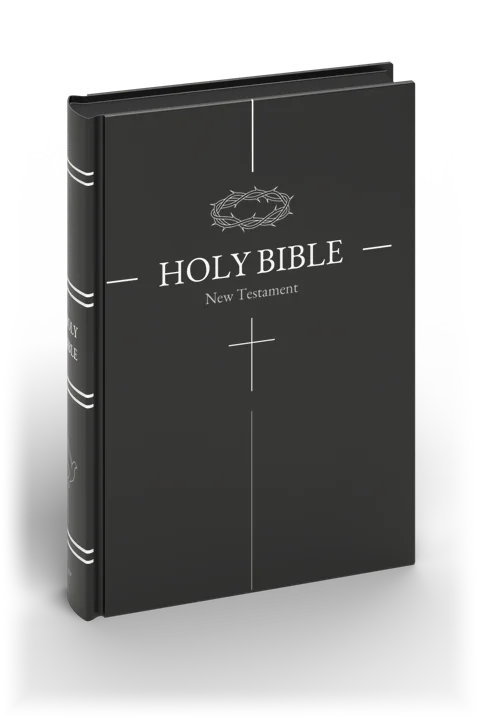
The Black Edition, King James Version
The complete New Testament in the KJV (the standard 1769 text), white text on black pages, the words of Jesus in red. A5, 392 pages.
Softcover $60 · Hardcover $80 · eBook $10 USD
See the KJV Black Edition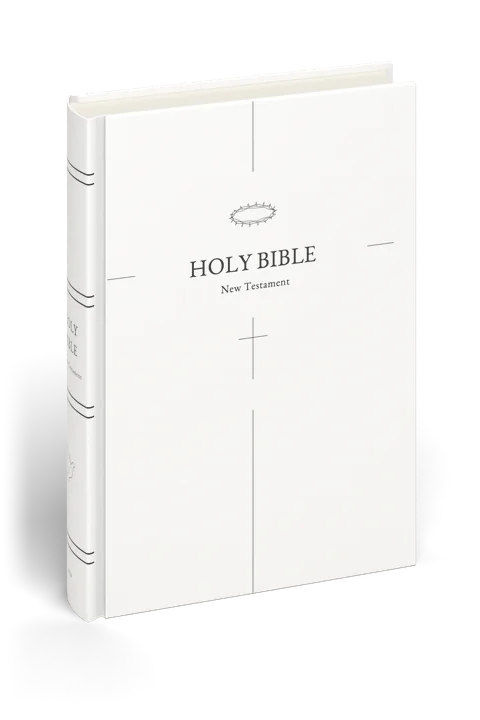
The White Edition New Testament
The same New Testament in classic black type on white pages, the words of Jesus in red. KJV, WEB, German or Danish.
Softcover $60 · Hardcover $80 · eBook $10 USD
See the White Edition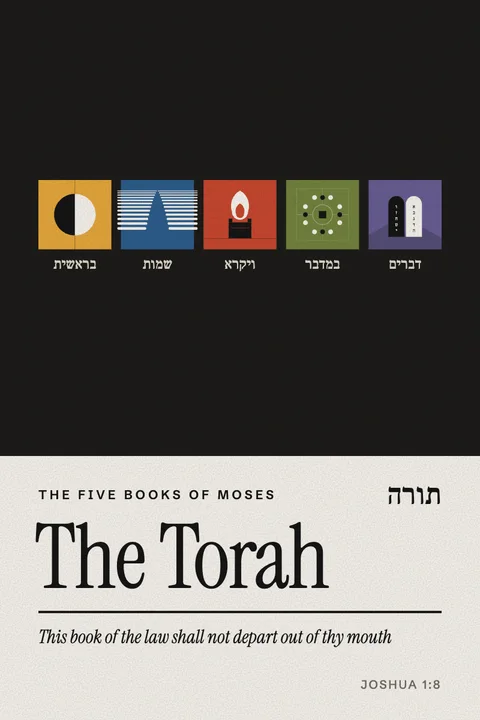
The Torah: the Five Books of Moses
Genesis to Deuteronomy, complete, in one volume with 31 full-page illustrations, or as five books. King James Version or World English Bible.
Softcover $60 · Hardcover $90 · eBook $10 USD
See the Torah
Prices in USD, tax included; shipping is calculated at checkout and free over $80. Printed books are printed to order; eBooks are a PDF and an ePub, emailed after payment.
Questions
More questions people ask
What does the King James Bible get wrong?
Critics point to translation choices such as “unicorn” in Numbers 23:22, for a Hebrew word lexicons define as a wild ox, and “Easter” in Acts 12:4, for a Greek word the KJV elsewhere renders “Passover.” Defenders explain both differently. The famous misprints were errors in particular printings, not in the standard text.
What is the Wicked Bible?
An edition of the King James Bible printed in London in 1631 that left “not” out of Exodus 20:14, so the seventh commandment read “Thou shalt commit adultery.” The copies were seized, the printers were fined £300, and of about 1,000 copies only around a dozen survive.
Was the King James Bible ever corrected?
Yes. Misprints, spelling and italics were corrected in editions of 1613, 1629, 1638 and 1762, and Benjamin Blayney’s Oxford edition of 1769 became the standard text, reprinted ever since with very few changes. These were corrections, not a new translation.
Can you trust the King James Bible?
The misprints that made headlines belong to particular old printings, and the standard 1769 text has changed very little since. Whether its translation choices and Greek text make it more or less reliable than modern Bibles is debated; our page Is the KJV the only true Bible? sets out both sides.
What are the He Bible and the She Bible?
They are the two issues of the first edition of the King James Bible. The 1611 printing reads “he went” at Ruth 3:15, and the 1613 reissue, printed from reset type, reads “she went,” the reading of the standard text today.
Sources
- lib.cam.ac.uk: No authoritative copy survives (lost in Great Fire); Barker’s errors; 1629 revision; Wicked Bible; Broughton; 800-page volume; 1717 Baskett Vinegar Bible
- lib.cam.ac.uk: 1611 riddled with misprints, italics muddled; Wicked Bible: £300 fine, a dozen of 1,000 survive; 1629: at least 493 changes; 1653 Unrighteous Bible
- lib.byu.edu: Ruth 3:15 reads “he went” where context calls for “she went”; corrected in the 1613 reissue from reset type; known as the He Bible and She Bible
- folger.edu: 1613 folio Judas Bible (Matthew 26:36); Wicked Bible seized, Barker prosecuted and fined; fines on Barker and Lucas, 1633; Deut 5:24 sabotage theory
- emerald.com (Library Review, 1976): “Printers have persecuted me without a cause” at Psalm 119:161 occurs in a few copies of the 1612 edition
- museumofthebible.org: Barker’s 1631 Bible omitted “not” in Exodus 20:14; Barker was fined; most copies were corrected or destroyed
- museumofthebible.org: “The Killer Bible,” London 1795: “filled” misprinted as “killed” in Mark 7:27
- rochestercathedral.org: Vinegar Bible printed by John Baskett of Oxford in 1717; running headline “Parable of the vinegar” for “vineyard”
- ccel.org: Revisions: 1629 and 1638 by John Bois and Samuel Ward, Cambridge; 1762 Thomas Paris, Cambridge; 1769 Benjamin Blayney, Oxford; 1873 Scrivener, Cambridge
- timeshighereducation.com: Blayney 1769 reprinted ever since; only six new changes and 30 restored since; Norton lists about 400 variants; Norton’s 2005 edition modernizes spelling
- archive.org: The Cambridge Paragraph Bible, text revised, with marginal references and a critical introduction; F. H. A. Scrivener; Cambridge University Press, 1873
- archive.org: Scrivener 1884: sections on 1611 italics, punctuation, spelling; wrong readings of 1611 amended later; 1629 began systematic revision, carried further in 1638
- blueletterbible.org: Hebrew re’em: KJV “unicorn” 9 times; Brown-Driver-Briggs: wild ox; Septuagint’s “one-horned” rendering called erroneous; Vulgate unicornis
- sites.google.com (KJV Today): Defense: “unicorn” simply means “one horn”; the KJV margin at Isaiah 34:7 reads “Or, Rhinoceros”
- webstersdictionary1828.com: Webster 1828: unicorn, an animal with one horn; the name is often applied to the rhinoceros
- blueletterbible.org: Greek pascha occurs 29 times; KJV renders it “Passover” 28 times and “Easter” once (Acts 12:4)
- sites.google.com (KJV Today): Defense of “Easter”: Luke writes as a Christian for Christian readers, so pascha in Acts 12:4 carries its Christian sense