The short answer
Most churches and Bible scholars say no. The belief that the King James Version is the only true English Bible, known as KJV-only, belongs to a movement found mainly in some fundamentalist and independent Baptist churches; most churches also use other translations, and many KJV readers make no claim that it is perfect. The KJV’s own translators wrote that a variety of translations helps readers find the sense of Scripture.
What “KJV-only” means
“KJV-only” is a name for the belief that the King James Version is the only acceptable English Bible and that modern translations should be set aside. It is not one single position. Views that are grouped under the name range from holding to the Greek and Hebrew texts behind the KJV to holding that its English words are themselves perfect, and the sources below describe at least these, from mildest to strongest:
- Received Text. The Trinitarian Bible Society uses only the KJV in English because it translates the Hebrew Masoretic Text and the Greek Received Text, which the Society believes God providentially preserved. Yet it says it “does not claim perfection” for the KJV, only that it needs no textual revision.
- Preserved, not inspired. Some KJV-only preachers call it the preserved word of God rather than an inspired translation. Evangelist Samuel Gipp told Christianity Today in 1995: “I call it the preserved Word of God.”
- Perfect in English. Some churches teach that the KJV itself is the perfect, inerrant word of God. A researcher who studied one such congregation in Ohio summed up its reasoning: a perfect God not only inspired a perfect Bible but also preserved one.
- Above the Greek. The strongest form, associated with Peter Ruckman, founder of Pensacola Bible Institute, holds that where the KJV and the Greek manuscripts disagree, the KJV should be considered authoritative.
These are very different claims, and much of the confusion in the debate comes from treating them as one.
Where the movement came from
According to historian Jeffrey Straub of Central Baptist Theological Seminary, the KJV-only movement grew largely out of opposition to newer translations: first the Revised Version of 1881 and the American Standard Version of 1901, and later the Revised Standard Version of 1952 and those that followed.
Several books shaped it. B. G. Wilkinson, a Seventh-day Adventist, wrote Our Authorized Bible Vindicated, which a committee of his own church reviewed critically in 1931. Edward Hills’s The King James Version Defended (1956) was, in the view of Kevin Bauder of Central Baptist Theological Seminary, less a KJV-only book than a defense of the Textus Receptus, and Peter Ruckman’s The Bible Babel appeared in 1964. Bauder calls David Otis Fuller’s Which Bible? (1970) the first major evangelical book to set out the KJV-only position for ordinary readers.
In 1978 a small group of KJV-only advocates organized the Dean Burgon Society. In 1993 Gail Riplinger’s New Age Bible Versions argued that modern translations reflect a widening apostasy; Christianity Today reported in 1995 that about 100,000 copies were in circulation, while critics such as James R. White faulted its use of quotations, and a 1994 review in the Christian Research Journal also rejected its arguments.
Where KJV-only is found today
Britannica notes that by the late 20th century the KJV had become the favored translation of English-speaking Christian fundamentalists, some of whom regarded it as divinely inspired. The evangelical writer Trevin Wax, who grew up among KJV-only believers, has described the controversy as raging in some fundamentalist circles of independent Baptist life.
It is a minority view even there. Bauder writes that when it spread in the 1970s the great majority of fundamentalists did not accept it. Speaking at Baylor University in 2011, Straub described KJV-only churches as a resilient subculture within American fundamentalism and said the internet has made even its most extreme forms accessible worldwide.
The movement is much smaller than the KJV’s readership. A 2014 study reported by Christianity Today found that 55 percent of Americans who read the Bible used the KJV, and Britannica notes that it remains the favored translation of a number of Protestant churches and denominations.
The case its defenders make
The most careful defense of the KJV starts with the text, not the English. The Trinitarian Bible Society argues that God “has providentially preserved His Word through all generations,” so that the church cannot have relied on corrupt manuscripts for nearly two thousand years. It notes that the Byzantine text behind the Received Text agrees with the great majority of surviving Greek manuscripts, more than 95 percent by its count.
Defenders add that the two oldest great codices, Vaticanus and Sinaiticus, disagree with each other thousands of times in the Gospels, and that modern Bibles built largely on them omit or bracket familiar passages such as Mark 16:9–20 and John 7:53–8:11. They value the KJV’s word-for-word method, its italics for words supplied in English, its “thee” and “thou,” which mark the singular, and its place as a shared standard among English-speaking Christians for centuries.
From this the stronger forms of KJV-only draw a further conclusion: if God preserved His word perfectly, there must be one perfect form of it in English today, and that form is the KJV. Critics who themselves think well of the KJV, such as the scholar Daniel Wallace, reject this step in particular, as the next section shows.
The main replies
The strongest reply comes from the KJV’s own translators. They did not see themselves as producing the first true English Bible but as revising earlier ones: their first rule was to follow the Bishops’ Bible and alter it only as far as the original required, and they relied heavily on the work of William Tyndale. In their preface, “The Translators to the Reader,” they wrote that their aim was “to make a good one better, or out of many good ones, one principal good one.”
The same preface defends having several translations. Citing Augustine, it says that “variety of Translations is profitable for the finding out of the sense of the Scriptures,” and the translators set alternative renderings in the margin where the text was not clear, because “diversity of signification and sense in the margin” must do good. They even affirmed that “the very meanest translation of the Bible in English” made by people of their own faith “containeth the word of God, nay, is the word of God.”
Critics also ask which KJV is meant. The text was revised in 1629 and 1638 at Cambridge and again in 1762 and 1769, and the 1769 Oxford revision by Benjamin Blayney is the form most people read today. The 1611 edition also included the Apocrypha, listed between Malachi and Matthew, which the Trinitarian Bible Society now excludes from the KJV it circulates.
Finally, scholars point to what has been found since 1611. Britannica notes that the great early Greek codices were not known or available to the translators, and scholar Daniel Wallace told Christianity Today that the manuscripts behind newer translations raise no doctrinal problems, while calling the KJV a fine translation but not the only legitimate one.
Quotations from the 1611 preface follow the modernized spelling of the Christian Classics Ethereal Library transcription.
What most churches and scholars hold
Outside the KJV-only movement, the common view is that the KJV is a faithful translation but not the only one. In the 20th century many mainstream Protestant churches turned to newer translations such as the Revised Standard Version, the NIV and the New Revised Standard Version, Britannica notes, and Catholic readers came to use approved translations such as the Jerusalem Bible and the New American Bible, Revised Edition.
Even the KJV’s firmest institutional defenders do not claim a consensus. The Trinitarian Bible Society acknowledges that the great majority of modern biblical scholars hold to the critical Greek text, and it claims for the KJV not perfection but that it is a thoroughly accurate translation of the Hebrew and Greek texts behind it.
For most Christians, then, the answer is no: the KJV is not the only true Bible, but it is a careful and historic translation that many still read with confidence. We print the New Testament in both the KJV and the World English Bible. If you are weighing the KJV against modern Bibles, see the most accurate Bible translations, NIV vs KJV and why the KJV is controversial, and for its history, King James Bible explained.
From our shelf
New Testaments we print in the KJV and WEB
We print the King James Version (the standard 1769 text), the World English Bible, the Lutherbibel 1912 and the Danish 1871/1907. In the United Kingdom, Jersey, Guernsey and the Isle of Man our books come in the World English Bible. We do not print a complete Bible, and not the NIV, ESV or other modern translations; for those, a bookshop or your church is the place.
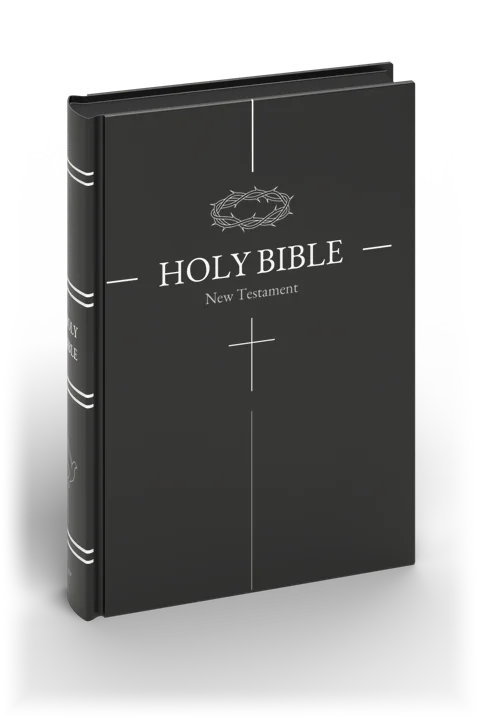
The Black Edition, King James Version
The complete New Testament in the KJV (the standard 1769 text), white text on black pages, the words of Jesus in red. A5, 392 pages.
Softcover $60 · Hardcover $80 · eBook $10 USD
See the KJV Black Edition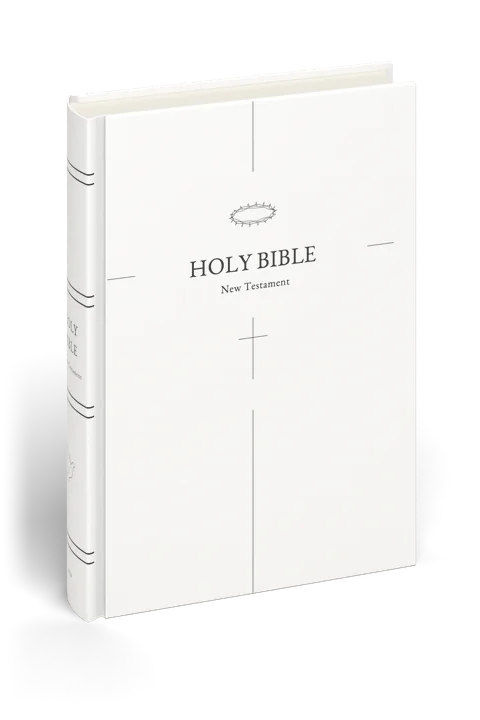
The White Edition New Testament
The same New Testament in classic black type on white pages, the words of Jesus in red. KJV, WEB, German or Danish.
Softcover $60 · Hardcover $80 · eBook $10 USD
See the White Edition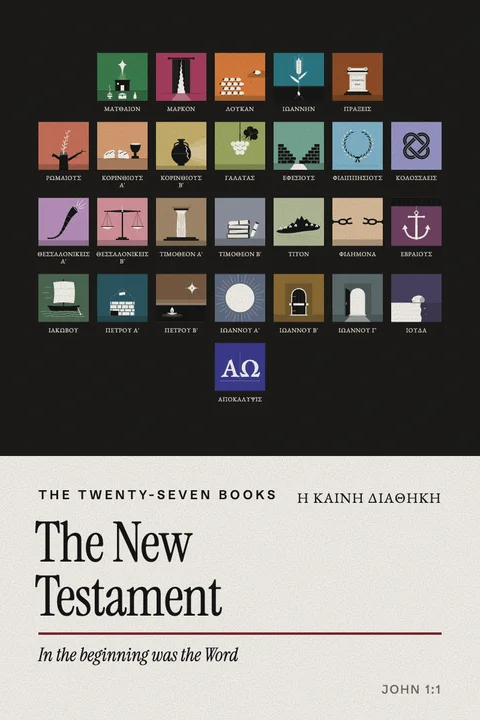
The illustrated New Testament, one volume
All 27 books, each opening with its own cover, 28 full-page illustrations, the words of Jesus in red. King James Version or World English Bible. 6 × 9 in.
Softcover $75 · Hardcover $90 · eBook $10 USD
See the New Testament
Prices in USD, tax included; shipping is calculated at checkout and free over $80. Printed books are printed to order; eBooks are a PDF and an ePub, emailed after payment.
Questions
More questions people ask
Is the King James Bible the correct Bible?
It is a careful translation that faithfully renders the Hebrew and Greek texts its translators used, but most churches do not regard it as the only correct one. Its own translators wrote that a variety of translations helps readers find the sense of Scripture.
Can you trust the King James Bible?
Yes. Its defenders call it a thoroughly accurate translation, critics such as Daniel Wallace call it a fine one, and Britannica says it was more faithful to the original languages and more scholarly than earlier English Bibles. Its limits are older vocabulary and a Greek text that most scholars think later manuscript discoveries have improved on.
Is the King James Bible the most authentic Bible?
No translation is the original; the question is which Hebrew and Greek texts it follows. The KJV follows the Masoretic Text and the Textus Receptus, which its defenders hold to be the providentially preserved text, while most modern scholars give more weight to older manuscripts that were not known or available in 1611.
Which Bible is closest to the original translation?
No English Bible is identical to the original Hebrew and Greek. Word-for-word translations such as the KJV stay closest to the original wording, and the main disagreement is over which manuscripts best preserve the original text: the Received Text behind the KJV or the older manuscripts behind most modern Bibles.
Sources
- tbsbibles.org: TBS case: providential preservation; Byzantine text in 95%+ of manuscripts; early codices disagree; verses bracketed; italics; thee/thou; a uniting standard
- tbsbibles.org: TBS “does not claim perfection” for the KJV but calls it thoroughly accurate; great majority of modern scholars hold to the Critical Text
- tbsbibles.org: TBS uses the Textus Receptus and rejects the Critical Text; the KJV translators relied heavily on the work of William Tyndale
- tbsbibles.org: TBS circulates the Authorised Version, excluding the Apocrypha, and seeks versions close to the Masoretic and Received texts
- christianitytoday.com: 1995: Riplinger’s New Age Bible Versions (1993), ~100,000 copies; Gipp: KJV preserved; White’s critique; Wallace: KJV fine, not the only legitimate one
- baptistnews.com: 2011, Jeffrey Straub at Baylor: KJV-only grew from opposition to RV 1881, ASV 1901, RSV 1952; Ruckman’s view; resilient subculture; Ohio church study
- centralseminary.edu: Bauder: Fuller’s Which Bible? (1970); Hills (1956) a TR defense; Ruckman’s The Bible Babel (1964); Dean Burgon Society 1978; most fundamentalists disagreed
- egwwritings.org: Howell, W. E., A Review of “Our Authorized Bible Vindicated,” by B. G. Wilkinson (1931), an Adventist committee review
- egwwritings.org: The Adventist review rejects Wilkinson’s claim that the American Revised Version distorts doctrine and warns against making it a test of orthodoxy
- christian.net: Christian Research Journal, Fall 1994: H. Wayne House’s critical review of G. A. Riplinger’s New Age Bible Versions (1993)
- thegospelcoalition.org: Trevin Wax (2007): the KJV-only controversy in fundamentalist circles of independent Baptist life; the 1769 revision is the most common KJV today
- britannica.com: KJV favored by a number of Protestant churches; mainstream Protestants turned to RSV, NIV, NRSV; Catholics to the Jerusalem Bible, NABRE; used Tyndale’s work
- britannica.com: KJV more faithful and scholarly than predecessors; by the late 20th century favored by fundamentalists, some regarding it as inspired; early codices unknown
- christianhistoryinstitute.org: Rule 1 for the translators: follow the Bishops’ Bible, as little altered as the truth of the original will permit
- ccel.org: 1611 preface: “to make a good one better”; “variety of Translations is profitable”; “diversity of signification and sense in the margin”
- ccel.org: 1611 preface: “the very meanest translation of the Bible in English” … “containeth the word of God, nay, is the word of God”
- ccel.org: KJV text revised 1629 and 1638 (Cambridge), 1762 and 1769, the last by Benjamin Blayney at Oxford
- ccel.org: The 1611 table of books lists “The Bookes called Apocrypha” between Malachi and Matthew
- christianitytoday.com: 2014 IUPUI study “The Bible in American Life”: 55 percent of Americans who read the Bible use the KJV, 19 percent the NIV