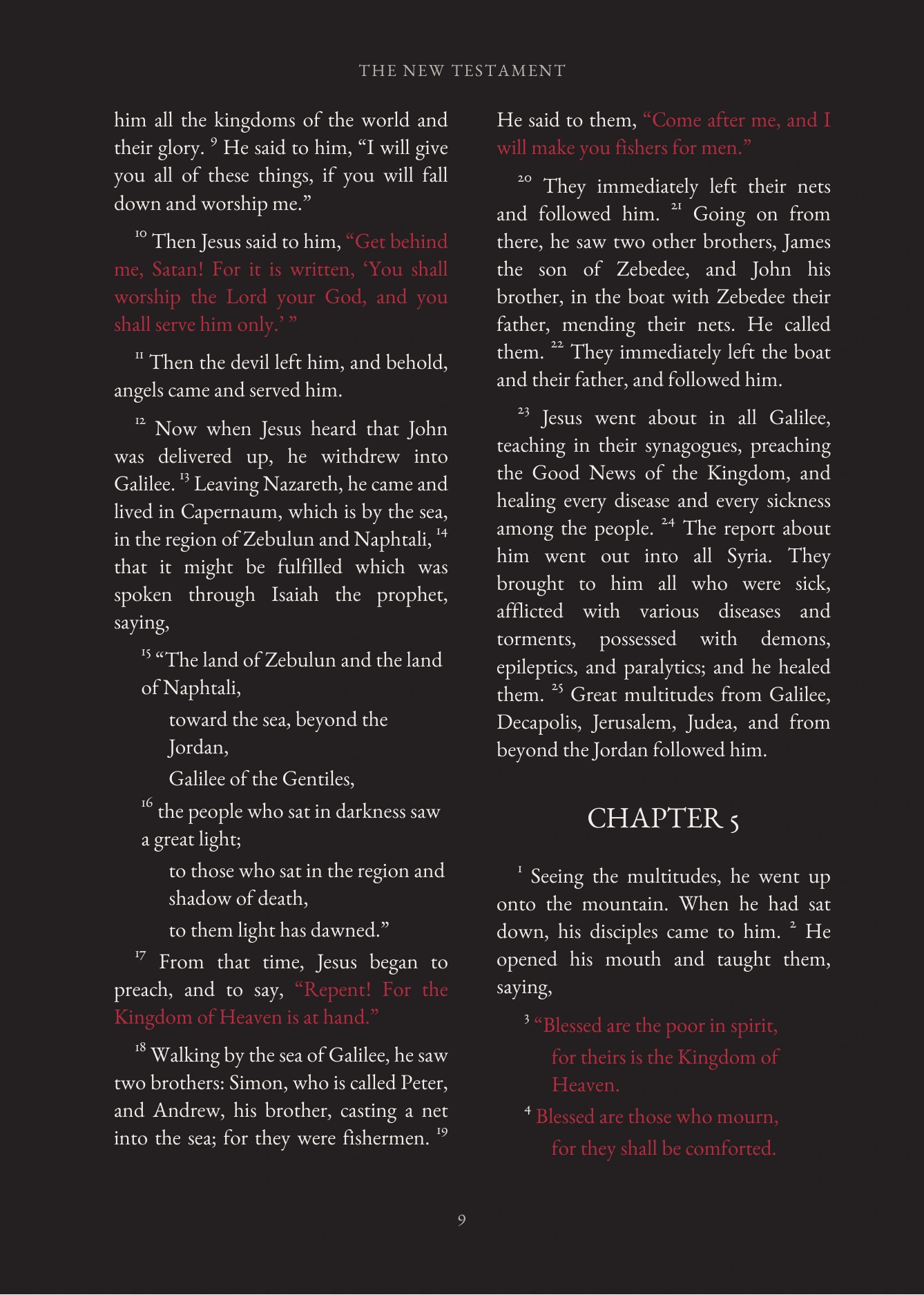
In a red-letter Bible, the words spoken by Jesus are printed in red ink and everything else in black (or, on black pages, in white). It is a simple idea, and it is younger than most readers think: the first red-letter New Testament was printed in 1899. This guide explains where the custom came from, why it helps, and something most explanations leave out. Deciding which words are "the words of Jesus" is an editorial judgement, and two respected translations do not always agree. We know because we print both, and we counted.
Where red letters came from
Scribes had used red ink for centuries, for headings, initials and instructions (the practice is called rubrication, from the Latin for red). Marking the speech of Jesus in red is a modern idea. The account usually given, for example in the history of the red letter edition, credits Louis Klopsch, the editor of the American magazine The Christian Herald. On 19 June 1899, while writing an editorial, he was reading Luke's account of the Last Supper:
Likewise also the cup after supper, saying, This cup is the new testament in my blood, which is shed for you.
Luke 22:20
Klopsch asked why the words of Jesus, who spoke of his blood, should not be printed in red. He put the idea to his mentor, the preacher Thomas De Witt Talmage, whose reply is usually quoted as "It could do no harm and it most certainly could do much good." Klopsch published a red-letter New Testament later in 1899, and a complete red-letter Bible followed in 1901. The format caught on quickly, and red-letter editions are still widely printed.
Why it helps, especially in the King James Version
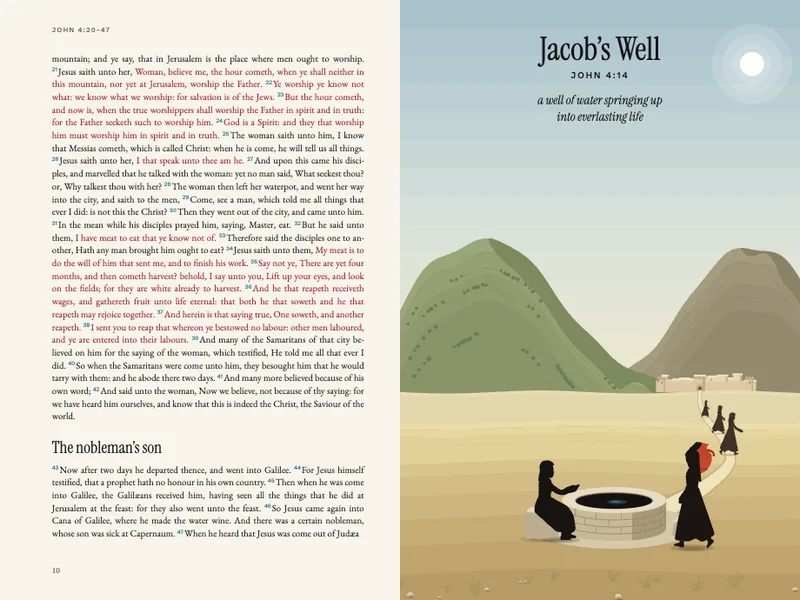
The King James Version has no quotation marks. In a passage like this one, the reader has to work out where the narrator stops and Jesus begins:
Jesus saith unto him, I am the way, the truth, and the life: no man cometh unto the Father, but by me.
John 14:6
Red letters do the work that quotation marks do in a modern translation, and they do it at a glance. Turning the pages of a red-letter Gospel, you see where the long teaching passages are (the Sermon on the Mount in Matthew 5–7 is almost entirely red) and where the story is told in narration. Modern translations such as the World English Bible do use quotation marks, but many readers still like the red, because it makes the voice of Jesus easy to find on a page.
How much of the New Testament is red?
We print the New Testament in both the King James Version and the World English Bible, with the words of Jesus in red in every book. Counting the verses that contain any red text gives these totals:
| Book | Verses | KJV red | WEB red |
|---|---|---|---|
| Matthew | 1,071 | 644 | 645 |
| Mark | 678 | 286 | 287 |
| Luke | 1,151 | 587 | 587 |
| John | 879 | 419 | 436 |
| Acts | 1,007 | 27 | 31 |
| 1 Corinthians | 437 | 2 | 2 |
| 2 Corinthians | 257 | 1 | 1 |
| 1 Timothy | 113 | 0 | 1 |
| Revelation | 404 | 62 | 69 |
| New Testament | 7,957 | 2,028 | 2,059 |
So roughly one verse in four in the New Testament contains words of Jesus, and in the Gospels it is about half. Matthew has the most (three verses in five), Mark the fewest of the four. Outside the Gospels the red is rare: the risen Jesus speaking to the disciples and to Saul in Acts, the words of the Last Supper in 1 Corinthians 11:24–25, "My grace is sufficient for thee" in 2 Corinthians 12:9, and the sayings of the risen Christ in Revelation, such as "I am Alpha and Omega, the beginning and the ending" (Revelation 1:8).
Who decides what is red?
The original Greek manuscripts have no quotation marks and no red ink. Every red-letter edition is the result of an editor deciding, verse by verse, where Jesus' words begin and end. Most cases are obvious. Some are not, and our two translations show it. The red in our books follows the markup in the source files of each translation (the eBible.org editions of the King James Version and the World English Bible). We did not add or remove red by our own judgement, so the differences below are differences between the two sources.
1. When someone else quotes Jesus
After Peter's third denial, the narrator repeats what Jesus had told him:
And Peter remembered the word of Jesus, which said unto him, Before the cock crow, thou shalt deny me thrice. And he went out, and wept bitterly.
WEBPeter remembered the word which Jesus had said to him, “Before the rooster crows, you will deny me three times.” Then he went out and wept bitterly.
Matthew 26:75
The King James source leaves this black, because Peter is remembering. The World English Bible source makes the remembered words red, because they are still Jesus' words. Most of the 17 extra red verses in the WEB of John are of this kind, such as John 8:22, where his opponents repeat his saying "Where I am going, you can’t come", and John 21:23, where the narrator corrects a rumour by quoting what Jesus actually said.
2. A voice from heaven
In Acts 10, Peter has a vision and hears "a voice" telling him, "Rise, Peter; kill, and eat" (Acts 10:13). The voice is not named, though Peter answers it as "Lord". The WEB source prints it red, which reads it as the voice of Jesus; the KJV source leaves it black. The same happens in Revelation 21:5–8, where "he that sat upon the throne said, Behold, I make all things new". In all, seven verses of Revelation are red in our WEB edition and black in our KJV edition, among them 16:15 and 22:14–15, where it is not stated who is speaking.
3. A saying of Jesus quoted in a letter
For the scripture saith, Thou shalt not muzzle the ox that treadeth out the corn. And, The labourer is worthy of his reward.
1 Timothy 5:18
The second saying is what Jesus says in Luke 10:7, "the labourer is worthy of his hire". The WEB source marks it red in 1 Timothy; the KJV source does not. That single verse is the only red in the whole of our WEB volume of Paul's letters from Galatians to Philemon.
4. A verse that one translation does not have
Luke 17:36, "Two men shall be in the field; the one shall be taken, and the other left", is red in the King James Version. It is not in the World English Bible at all, because the Greek text the WEB translates does not contain it. So the counts differ for a reason that has nothing to do with red ink.
5. Where a conversation ends
The most famous verse in the Bible is a case where the two sources agree, but other editions do not. John 3 records a night-time conversation between Jesus and Nicodemus. At some point the speech of Jesus may give way to the reflections of the Gospel writer, and some translations note that the quotation could end at verse 15. In both our sources, the red continues to the end of verse 21, so John 3:16 is printed in red:
For God so loved the world, that he gave his only begotten Son, that whosoever believeth in him should not perish, but have everlasting life.
John 3:16
None of these differences changes what the text says. They change only which words are printed in which colour. They are a good reminder that the red is a reading aid added by editors, not part of the inspired text.
Do red letters make some words more important?
Some readers and teachers dislike red-letter editions for exactly that reason: they worry that the red suggests the words of Jesus matter more than the rest of Scripture, or that the black words of Paul or Moses can be skipped. Klopsch himself saw it differently: according to the same histories, his 1901 Bible also marked the Old Testament passages that Jesus quoted, to show how the two Testaments are linked. Whether you prefer red letters is a matter of taste and habit. If you like them, they make the Gospels easier to navigate. If you do not, every passage is still there in the same order.
Which of our books have red letters?
Every book in our illustrated New Testament series prints the words of Jesus in red, in both the King James Version and the World English Bible: the four Gospels, Acts and Revelation as single books, the letters in three volumes, and the whole New Testament in one volume. The red is a deep wine colour on white pages, chosen to stay readable in long passages. Our eighteen theme books of Scripture also print the words of Jesus in red wherever they quote him, for example in the Sermon on the Mount in the Character book or "Peace I leave with you" in the Peace book. The Five Books of Moses have no red letters, because Jesus does not speak in the Torah.
Our two A5 New Testaments are red-letter editions too, in the World English Bible. The Black Edition prints red and white text on black pages, and the White Edition prints red and black text on white pages. You can compare them in the Black Edition sample and the White Edition sample, or read about the choice in Black vs White Bible.