The New Testament opens with four accounts of the life of Jesus. They tell the same story of a Galilean teacher who is crucified in Jerusalem and rises again, and they tell it in four different ways. Matthew, Mark and Luke are so close in places that they can be printed in parallel columns, which is why they are called the "synoptic" Gospels (from a Greek word for "seen together"). John stands apart. This guide sets out the differences that matter when you read them: how each begins, how each is built, what only that Gospel contains, and how much of each is in the words of Jesus. The numbers come from our own editions of Matthew, Mark, Luke and John, counted from the texts we print.
The four Gospels at a glance
| Gospel | Chapters | Verses | Words (KJV) | Red-letter verses | Opening |
|---|---|---|---|---|---|
| Matthew | 28 | 1,071 | about 23,700 | 644 (60%) | A genealogy from Abraham |
| Mark | 16 | 678 | about 15,200 | 286 (42%) | John the Baptist in the wilderness |
| Luke | 24 | 1,151 | about 25,900 | 587 (51%) | A preface to Theophilus |
| John | 21 | 879 | about 19,100 | 419 (48%) | "In the beginning was the Word" |
Two things stand out. Luke is the longest Gospel, and Mark is little more than half its length. And Matthew, with its five long sermons, has the highest share of verses spoken by Jesus: three verses in five.
Four openings, four starting points
The quickest way to see how the Gospels differ is to read their first verses side by side. Each one starts the story at a different point in time.
The book of the generation of Jesus Christ, the son of David, the son of Abraham.
Matthew 1:1
The beginning of the gospel of Jesus Christ, the Son of God;
Mark 1:1
Forasmuch as many have taken in hand to set forth in order a declaration of those things which are most surely believed among us […] It seemed good to me also, having had perfect understanding of all things from the very first, to write unto thee in order, most excellent Theophilus.
Luke 1:1–3
In the beginning was the Word, and the Word was with God, and the Word was God.
John 1:1
Matthew begins with Abraham and David, the fathers of Israel and of its kings. Mark has no birth story at all: by verse 4 John the Baptist is preaching, and by verse 9 Jesus is an adult being baptised. Luke begins like a historian, with a dedication and a promise of an orderly account, and then gives the births of both John and Jesus. John begins before creation, echoing the first words of Genesis.
Matthew: the teacher and the fulfilment of the Scriptures
Matthew is the Gospel most concerned with the Jewish Scriptures. The words "might be fulfilled" occur ten times in its King James text, each pointing to a prophecy the events fulfil, from the virgin birth (1:22) to the division of the garments at the cross (27:35). John uses them seven times; Mark and Luke not at all. Jesus says of himself, in words printed in red in our edition:
Think not that I am come to destroy the law, or the prophets: I am not come to destroy, but to fulfil.
Matthew 5:17
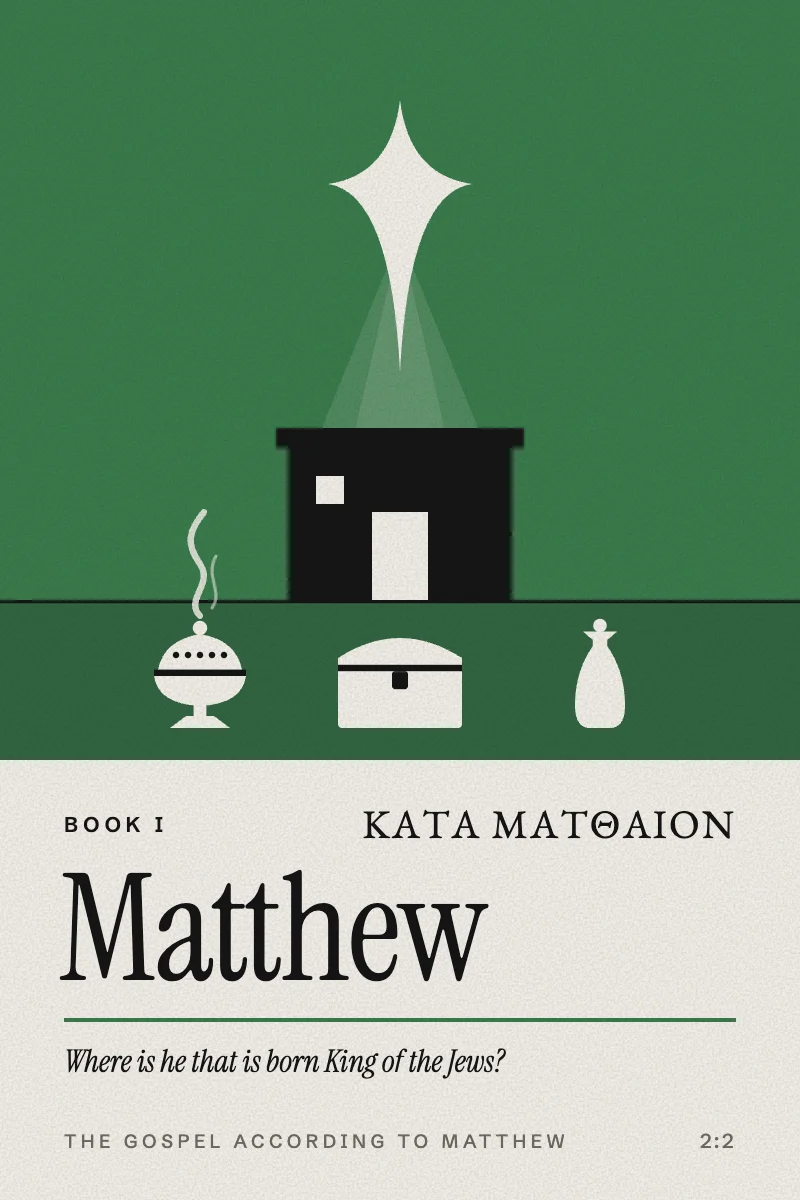
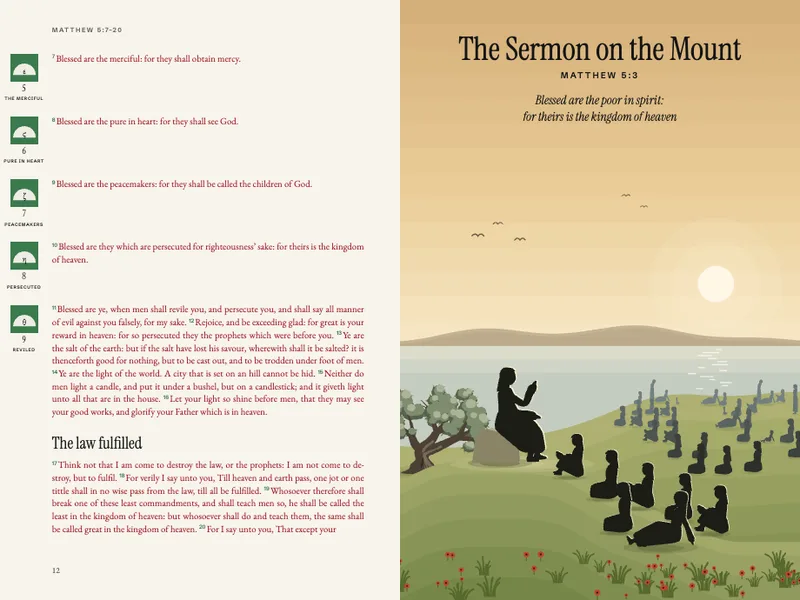
Matthew is also built around five long blocks of teaching, each closing with nearly the same sentence, "when Jesus had ended these sayings" or "finished" (7:28, 11:1, 13:53, 19:1, 26:1): the Sermon on the Mount (chapters 5–7), the sending of the twelve (10), the parables of the kingdom (13), life in the community of disciples (18), and the last things (24–25). That is why so much of Matthew is red. It is the Gospel to read for the teaching of Jesus gathered in one place, and it ends with the commission to "teach all nations" and the promise "lo, I am with you alway, even unto the end of the world" (28:19–20). The cover of our Matthew shows three strings of fourteen discs on three steps, the generations of 1:17.
Mark: the shortest and the fastest
Mark moves quickly. In the King James Version, "straightway" occurs 19 times in Mark and "immediately" 17 times. The World English Bible translates both with "immediately", and that word occurs 42 times in Mark's sixteen chapters, against 19 in Matthew and 18 in Luke. Scenes follow one another without pause, and much of the book is action rather than speech, which is why it has the lowest share of red-letter verses of the four.
More than a third of Mark is taken up with the last week in Jerusalem, from the entry into the city in chapter 11 to the empty tomb in chapter 16. One verse sums up the whole Gospel:
For even the Son of man came not to be ministered unto, but to minister, and to give his life a ransom for many.
Mark 10:45
Mark is the best Gospel to read in one sitting: at about 15,000 words, it takes an evening. Its cover in our series is the veil of the temple "rent in twain from the top to the bottom" (15:38), the moment of Jesus' death. One note on the text: the last twelve verses, Mark 16:9–20, are missing from some of the oldest Greek manuscripts. Both the King James Version and the World English Bible print them, and so do our editions.
Luke: the careful account, the lost and the found
Luke is the longest Gospel, and the only one that tells us why and how it was written: from eyewitnesses, "in order", for a reader named Theophilus. The same author wrote Acts, which opens by addressing the same reader: "The former treatise have I made, O Theophilus, of all that Jesus began both to do and teach" (Acts 1:1). Read together, Luke and Acts carry the story from Jerusalem to Rome.
Many of the best-loved parables appear only in Luke: the Good Samaritan (10:25–37), the lost coin and the prodigal son (chapter 15, after the lost sheep, which Matthew also tells), the rich man and Lazarus (16:19–31), and the Pharisee and the publican (18:9–14). Luke has a particular eye for the poor, for women, for outsiders and for prayer. Its key verse is:
For the Son of man is come to seek and to save that which was lost.
Luke 19:10
Luke also gives the fullest account of Jesus' birth (chapters 1–2), which is why it is read at Christmas. Our cover shows the ninety and nine kept together and the one sheep found far off: "I have found my sheep which was lost" (15:6).
John: signs, long conversations and "I am"
John differs from the other three in almost every way. Most of the story takes place in and around Jerusalem rather than Galilee. Instead of many short scenes, John tells fewer events at greater length: seven signs, starting with the water turned into wine at Cana (2:1–11), several of them followed by a long conversation or discourse. John contains none of the story parables that fill Luke and Matthew. Instead, Jesus describes himself in a series of sayings that begin with "I am":
- "I am the bread of life" (6:35)
- "I am the light of the world" (8:12)
- "I am the door" (10:9)
- "I am the good shepherd" (10:11)
- "I am the resurrection, and the life" (11:25)
- "I am the way, the truth, and the life" (14:6)
- "I am the true vine" (15:1)
John also has its own way of introducing a solemn saying. "Verily, verily, I say unto thee" occurs 25 times in the King James text of John and never in the other three Gospels, which use a single "verily". Chapters 13 to 17, the evening before the crucifixion, are almost entirely the words of Jesus to his disciples, ending with his prayer for them. Near the end, John states its purpose in a single sentence:
But these are written, that ye might believe that Jesus is the Christ, the Son of God; and that believing ye might have life through his name.
John 20:31
Our John has a corn of wheat on its cover, fallen into the ground and bearing a full ear above it: "if it die, it bringeth forth much fruit" (12:24).
What all four share
For all their differences, the four Gospels agree on the shape of the story. All four begin Jesus' public life with John the Baptist. All four tell the feeding of the five thousand, the only miracle, apart from the resurrection itself, that every Gospel records. All four slow down for the last week in Jerusalem, and all four tell the arrest, the trial before Pilate, the crucifixion and the empty tomb on the first day of the week. If you want to see how they handle that week side by side, read Matthew 26–28, Mark 14–16, Luke 22–24 and John 18–21 in turn.
Which Gospel should you read first?
There is no single right order, but each Gospel suits a different reader:
- Mark if you want the whole story quickly, or are reading a Gospel for the first time.
- Matthew if you want the teaching of Jesus, including the Sermon on the Mount and the Lord's Prayer.
- Luke if you want the fullest narrative, the birth stories and the great parables, and plan to continue with Acts.
- John if you want to understand who Jesus says he is. It is often the Gospel people return to most.
Whichever you choose, read it as a book, not as a collection of verses. Each Gospel was written to be read from beginning to end.
Reading the Gospels as separate books
Most Bibles print the Gospels one after another in small type, which hides how different they are. In our illustrated New Testament series, each Gospel is its own book, with its own colour, symbol and verse on the cover, full-page illustrations at the turning points of the story, and the words of Jesus in red. Each comes in the King James Version or the World English Bible, as an eBook and as a hardcover (Matthew 80 pages, Mark 52, Luke 78 and John 64 in the King James Version). If you prefer all four in one place, the New Testament in one volume holds all 27 books, each opening with its own cover. For how the red letters are decided, and where the two translations disagree, see why Jesus' words are printed in red.