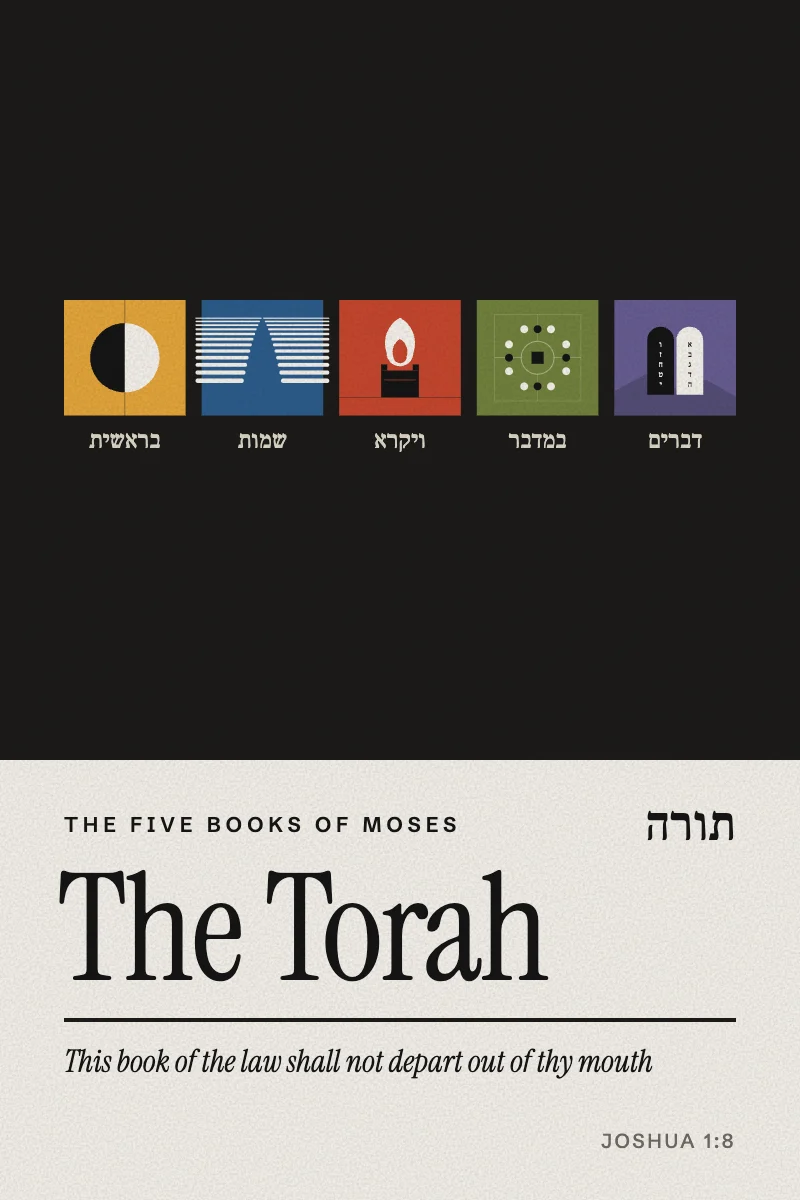
The first five books of the Bible are Genesis, Exodus, Leviticus, Numbers and Deuteronomy. Together they are called the Torah, the Pentateuch or the Five Books of Moses. They run from the creation of the world to the death of Moses on the edge of the promised land, and every later book of the Bible looks back to them. This guide gives their order, their names in Hebrew, Greek and English, and what each one is about, with the turning points of each book as we chose them for the full-page illustrations in our illustrated Five Books of Moses.
The five books in order
| # | English | Hebrew name | Meaning | Chapters | Verses |
|---|---|---|---|---|---|
| 1 | Genesis | Bereshit | "In the beginning" | 50 | 1,533 |
| 2 | Exodus | Shemot | "Names" | 40 | 1,213 |
| 3 | Leviticus | Vayikra | "And he called" | 27 | 859 |
| 4 | Numbers | Bemidbar | "In the wilderness" | 36 | 1,288 |
| 5 | Deuteronomy | Devarim | "Words" | 34 | 959 |
| The Torah | 187 | 5,852 |
Three sets of names
Each book has a Hebrew name, taken from one of its first words. You can see it in the opening verse of each book, even in English:
- Bereshit: "In the beginning God created the heaven and the earth." (Genesis 1:1)
- Shemot: "Now these are the names of the children of Israel, which came into Egypt." (Exodus 1:1)
- Vayikra: "And the LORD called unto Moses, and spake unto him out of the tabernacle of the congregation." (Leviticus 1:1)
- Bemidbar: "And the LORD spake unto Moses in the wilderness of Sinai." (Numbers 1:1)
- Devarim: "These be the words which Moses spake unto all Israel." (Deuteronomy 1:1)
The English names come, through Latin, from the Greek translation of the Hebrew Scriptures known as the Septuagint, and they describe the content instead. Genesis means origin or birth. Exodus means a going out, the departure from Egypt. Leviticus is the book of the Levites, the priestly tribe. Numbers is named after the two censuses of Israel in chapters 1 and 26. Deuteronomy means "second law". It goes back to the Greek rendering of a phrase in Deuteronomy 17:18, where the king is told to write "a copy of this law", and it fits a book that restates the law for a new generation.
"Torah" is usually translated "law", but its root sense is teaching or instruction. "Pentateuch" is Greek for "five volumes", from the days when each book was copied on its own scroll. That is also why we print each book as a volume of its own, as well as all five together.
Genesis: beginnings
Genesis covers more time than the other four books together. Its first eleven chapters tell the beginnings of the world and of humankind: creation, the garden, the flood, Babel. From chapter 12 it narrows to one family, beginning with the call of Abram:
And I will make of thee a great nation, and I will bless thee, and make thy name great; and thou shalt be a blessing […] and in thee shall all families of the earth be blessed.
Genesis 12:2–3
The rest of the book follows four generations: Abraham, Isaac, Jacob and Joseph, ending with Jacob's family in Egypt and Joseph's words to his brothers: "ye thought evil against me; but God meant it unto good" (Genesis 50:20). The seven illustrations in our Genesis mark its turning points: Eden (2:8–14), East of Eden (3:24), the bow in the cloud (9:13), Babel (11:1–9), "count the stars" (15:5), Jacob's ladder at Bethel (28:12) and the corn stored in Egypt (41:49). The cover shows a circle split into light and dark, for "God divided the light from the darkness" (1:4).
Exodus: out of Egypt
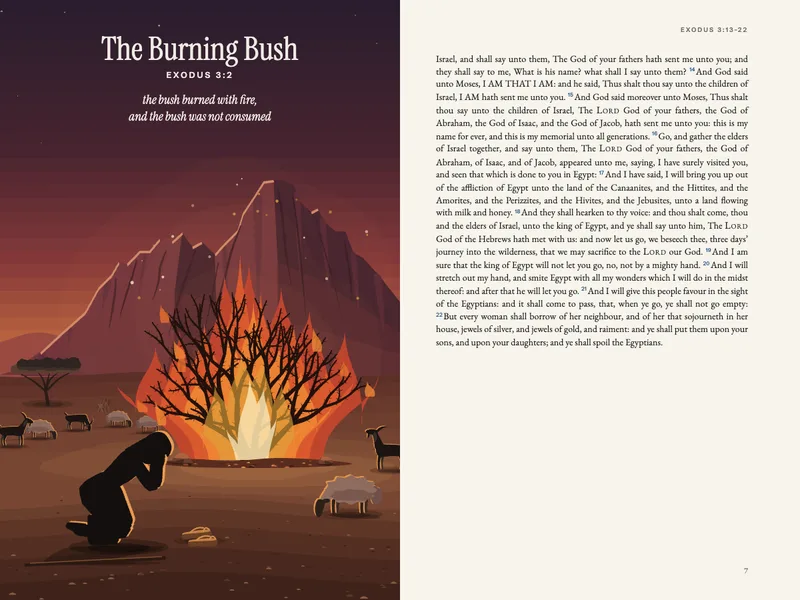
Exodus opens after the death of Joseph, when "there arose up a new king over Egypt" (1:8) and Jacob's descendants are made slaves. God calls Moses from a burning bush and reveals his name:
And God said unto Moses, I AM THAT I AM: and he said, Thus shalt thou say unto the children of Israel, I AM hath sent me unto you.
WEBGod said to Moses, “I AM WHO I AM,” and he said, “You shall tell the children of Israel this: ‘I AM has sent me to you.’ ”
Exodus 3:14
The first half of the book is the deliverance: the plagues, the Passover and the crossing of the sea, where "the waters were a wall unto them on their right hand, and on their left" (14:22), the verse on our Exodus cover. The second half takes place at Mount Sinai: the Ten Commandments (chapter 20), the covenant, the golden calf, and the building of the tabernacle, which the glory of the Lord fills in the last chapter. Our seven Exodus illustrations follow that arc, from the burning bush (3:2) to the glory over the tabernacle (40:38).
Leviticus: a holy people
Leviticus is the book readers most often skip, and the one that most rewards a slower reading. It has almost no story. Instead, it gives the laws of sacrifice, the duties of the priests, the rules of clean and unclean, and the calendar of feasts. Its central idea is holiness:
Ye shall be holy: for I the LORD your God am holy.
Leviticus 19:2
The same chapter contains the commandment Jesus calls the second greatest: "thou shalt love thy neighbour as thyself" (19:18). Chapter 16 describes the Day of Atonement and the scapegoat, and chapter 25 the year of jubilee, when land returned to its families and liberty was proclaimed "throughout all the land". Our five Leviticus illustrations are the fire from the Lord (9:24), the scapegoat (16:22), the booths of the harvest feast (23:42), the lamps of the tabernacle (24:4) and the jubilee (25:10). The cover is a flame on a horned altar: "The fire shall ever be burning upon the altar; it shall never go out" (6:13).
Numbers: forty years in the wilderness
Numbers begins with a census at Sinai and the arrangement of the camp, with the twelve tribes around the tabernacle, "every man of the children of Israel shall pitch by his own standard" (2:2). Our cover draws that plan: four groups of three tribes, each led by a standard. Then the people set out. When the spies return from Canaan with a cluster of grapes so large it is carried on a pole (13:23), the people refuse to enter the land, and they are sentenced to wander until a new generation has grown up:
And your children shall wander in the wilderness forty years […] until your carcases be wasted in the wilderness.
Numbers 14:33
Numbers also holds the priestly blessing, which is still spoken at the end of many services: "The LORD bless thee, and keep thee: The LORD make his face shine upon thee, and be gracious unto thee: The LORD lift up his countenance upon thee, and give thee peace" (6:24–26). Our six illustrations are the camp (2:2), the grapes of Eshcol (13:23), Aaron's rod that budded (17:8), water from the rock (20:11), the serpent of brass (21:9) and Balaam and the angel (22:24).
Deuteronomy: the words of Moses
Deuteronomy is set on the plains of Moab, just before Israel crosses the Jordan. It consists mostly of Moses' farewell speeches, retelling the journey and restating the law for the generation born in the wilderness. Its heart is the Shema, the confession of faith that Jesus quotes as the first and great commandment (Matthew 22:37–38):
4Hear, O Israel: The LORD our God is one LORD: 5And thou shalt love the LORD thy God with all thine heart, and with all thy soul, and with all thy might.
WEBHear, Israel: Yahweh is our God. Yahweh is one. You shall love Yahweh your God with all your heart, with all your soul, and with all your might.
Deuteronomy 6:4–5
It also gives Jesus his answer to the first temptation, "man doth not live by bread only" (8:3), and ends Moses' teaching with a choice: "I have set before you life and death, blessing and cursing: therefore choose life" (30:19). The last chapter tells of Moses' death on Mount Nebo, looking over the land he will not enter, and closes: "there arose not a prophet since in Israel like unto Moses, whom the LORD knew face to face" (34:10). Our six illustrations run from the voice out of the fire (5:22) and the words written on the doorposts (6:9) to the view from Nebo (34:4). The cover shows the two tablets, lettered with the first ten letters of the Hebrew alphabet, alef to yod, in the traditional way, the first five on the right.
Who wrote the Five Books of Moses?
Jewish and Christian tradition has long called these books the books of Moses, and the New Testament speaks of "the law of Moses" (Luke 24:44). The books themselves are mostly anonymous; they describe Moses in the third person and record his death. Since the nineteenth century many scholars have argued that the Torah was compiled from several sources over a long period, while others hold to Mosaic authorship. This guide does not take a side. Whichever view you hold, the five books were read as one work for well over two thousand years, and they make most sense read in order.
How to read them
- Start with Genesis and Exodus 1–20. They are mostly narrative and move quickly.
- Read Leviticus with a purpose. Look for what it says about holiness, forgiveness and the neighbour, rather than trying to master every law.
- Read Numbers as a journey. It is the story of a generation that came out of Egypt and did not reach the land.
- Read Deuteronomy aloud. It was written as speech, and it sounds like a farewell.
The whole Torah is about 157,000 words in the King James Version (about 147,000 in the World English Bible). At a steady pace that is a few weeks of evening reading.
The Five Books of Moses as five illustrated books
We publish the Torah as five separate minimalist books and as one volume. Each book has one colour, one constructed symbol and one verse on its cover, the complete text set as continuous prose, and full-page illustrations at the turning points listed above: 31 in all. You can choose the King James Version (the standard 1769 text) or the World English Bible, as an eBook (designed PDF and ePub) or a 6 × 9 in hardcover. The one-volume Torah holds all five books, each with its own frontispiece and overview, in 492 pages in the King James Version or 478 in the World English Bible. If you want to continue the story, the same design carries on in our illustrated New Testament, and the verses of the Torah also run through our theme books of Scripture, from the creation of man and woman in the Marriage book to the priestly blessing that closes the Peace book.