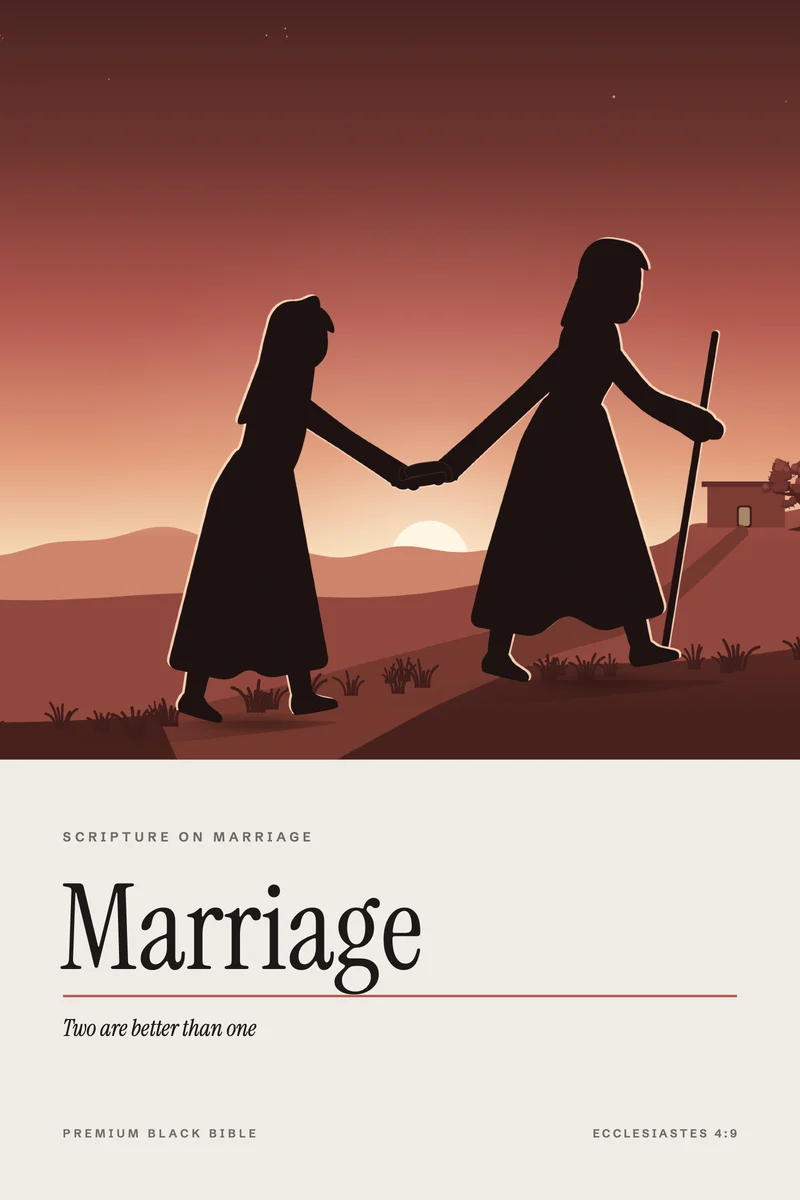
Most lists of Bible verses about marriage give you one line each, cut from its chapter. This page does it differently. The verses below follow the eight sections of our Marriage theme book, which gathers 37 passages and 357 verses on husband and wife, from the garden of Eden to the wedding supper of the Lamb. Each verse is quoted in the King James Version, with the World English Bible (WEB) beside it where the wording differs, and every reference is given, so you can read the whole passage around a line before you use it in a card, a toast or a vow.
1. In the beginning
The Bible's teaching on marriage starts before there is any law or nation, in the second chapter of Genesis. The first thing God calls "not good" in the whole creation account is a man on his own:
And the LORD God said, It is not good that the man should be alone; I will make him an help meet for him.
WEBYahweh God said, “It is not good for the man to be alone. I will make him a helper comparable to him.”
Genesis 2:18
The chapter ends with the sentence that every later passage on marriage comes back to:
Therefore shall a man leave his father and his mother, and shall cleave unto his wife: and they shall be one flesh.
WEBTherefore a man will leave his father and his mother, and will join with his wife, and they will be one flesh.
Genesis 2:24
Jesus quotes this verse when he is asked about divorce in Matthew 19, and adds one line of his own. It is often read at weddings, and it is printed in red in our book, because these are his words:
Wherefore they are no more twain, but one flesh. What therefore God hath joined together, let not man put asunder.
WEBSo that they are no more two, but one flesh. What therefore God has joined together, don’t let man tear apart.
Matthew 19:6
Read Matthew 19:3–9 as a whole before using verse 6. The question Jesus answers is about divorce, and his reply reaches back past the law of Moses to "the beginning". That is why the Marriage book opens its first section with Genesis 1:26–28, Genesis 2:18–25 and Matthew 19:3–9 side by side.
2. A wife for Isaac
Genesis 24 is the longest chapter in Genesis, and it is entirely about finding a wife: Abraham's servant travels to Mesopotamia, prays at a well and meets Rebekah. The chapter ends quietly:
And Isaac brought her into his mother Sarah’s tent, and took Rebekah, and she became his wife; and he loved her: and Isaac was comforted after his mother’s death.
WEBIsaac brought her into his mother Sarah’s tent, and took Rebekah, and she became his wife. He loved her. So Isaac was comforted after his mother’s death.
Genesis 24:67
It is an honest verse to read at a wedding where a family has recently lost someone: love in a marriage does not erase grief, but it can comfort it.
3. Jacob and Rachel, Ruth and Boaz
Two love stories in the Old Testament are told at length. Jacob works for his uncle Laban to marry Rachel, and the narrator gives one of the gentlest lines in Genesis:
And Jacob served seven years for Rachel; and they seemed unto him but a few days, for the love he had to her.
WEBJacob served seven years for Rachel. They seemed to him but a few days, for the love he had for her.
Genesis 29:20
The book of Ruth is a story of loyalty before it is a love story. Boaz praises Ruth with a phrase that matters later in this list:
And now, my daughter, fear not; I will do to thee all that thou requirest: for all the city of my people doth know that thou art a virtuous woman.
WEBNow, my daughter, don’t be afraid. I will do to you all that you say; for all the city of my people knows that you are a worthy woman.
Ruth 3:11
Their marriage in Ruth 4:13 leads to a son, Obed, "the father of Jesse, the father of David" (Ruth 4:17). The book closes a family's grief with a wedding and a birth. The famous words "whither thou goest, I will go" (Ruth 1:16) are often read at weddings, but in the story Ruth says them to Naomi, her mother-in-law. They are a promise of faithfulness between two widows, which is no reason not to use them, as long as you know where they come from.
4. A love song
The Song of Solomon is a book of love poetry between a bride and her beloved, and the Wisdom books add their own advice to married people. The Marriage book gathers them in one section. Three lines from it:
10My beloved spake, and said unto me, Rise up, my love, my fair one, and come away. 11For, lo, the winter is past, the rain is over and gone; 12The flowers appear on the earth; the time of the singing of birds is come […]
Song of Solomon 2:10–12
My beloved is mine, and I am his: he feedeth among the lilies.
WEBMy beloved is mine, and I am his. He browses among the lilies.
Song of Solomon 2:16
6Set me as a seal upon thine heart, as a seal upon thine arm: for love is strong as death […] 7Many waters cannot quench love, neither can the floods drown it.
WEBSet me as a seal on your heart, as a seal on your arm; for love is strong as death. […] Many waters can’t quench love, neither can floods drown it.
Song of Solomon 8:6–7
Song of Solomon 8:7, "Many waters cannot quench love", is one of the passages of our Love theme book. Next to the poetry, Proverbs and Ecclesiastes speak to people who have been married for years: "rejoice with the wife of thy youth" (Proverbs 5:18), and "Live joyfully with the wife whom thou lovest all the days of the life of thy vanity" (Ecclesiastes 9:9).
5. Husbands and wives
The New Testament letters speak to married couples directly. The best-known passage is Ephesians 5, and it is worth starting one verse earlier than most lists do, because verse 21 frames everything after it:
Submitting yourselves one to another in the fear of God.
Ephesians 5:21
Husbands, love your wives, even as Christ also loved the church, and gave himself for it.
WEBHusbands, love your wives, even as Christ also loved the assembly and gave himself up for her.
Ephesians 5:25
Paul then quotes Genesis 2:24 again (Ephesians 5:31) and calls it "a great mystery", speaking "concerning Christ and the church". Colossians 3 gives the same teaching in a shorter form, and its verses 12 to 14 are among the most practical in the Bible for living together:
12Put on therefore, as the elect of God, holy and beloved, bowels of mercies, kindness, humbleness of mind, meekness, longsuffering; 13Forbearing one another, and forgiving one another, if any man have a quarrel against any: even as Christ forgave you, so also do ye. 14And above all these things put on charity, which is the bond of perfectness.
WEB12Put on therefore, as God’s chosen ones, holy and beloved, a heart of compassion, kindness, lowliness, humility, and perseverance; 13bearing with one another, and forgiving each other, if any man has a complaint against any; even as Christ forgave you, so you also do. 14Above all these things, walk in love, which is the bond of perfection.
Colossians 3:12–14
Peter adds that husband and wife are "heirs together of the grace of life" (1 Peter 3:7). The prophet Malachi uses a word that is easy to miss: the wife is "thy companion, and the wife of thy covenant" (Malachi 2:14). And Hebrews 13:4 opens with "Marriage is honourable in all". The section in the book also holds 1 Corinthians 7:1–16 and 11:11–12. Read whole letters when you can: these instructions were written to real churches with real questions.
6. A wife of worth
Proverbs praises a good marriage as a gift rather than an achievement:
Whoso findeth a wife findeth a good thing, and obtaineth favour of the LORD.
WEBWhoever finds a wife finds a good thing, and obtains favor of Yahweh.
Proverbs 18:22
House and riches are the inheritance of fathers: and a prudent wife is from the LORD.
Proverbs 19:14
The book closes with a 22-verse poem, Proverbs 31:10–31, which is an acrostic in Hebrew: each verse begins with the next letter of the alphabet. It opens with "Who can find a virtuous woman? for her price is far above rubies", and it ends with the verse that puts character above appearance:
Favour is deceitful, and beauty is vain: but a woman that feareth the LORD, she shall be praised.
WEBCharm is deceitful, and beauty is vain; but a woman who fears Yahweh, she shall be praised.
Proverbs 31:30
"Virtuous woman" in Proverbs 31:10 is the same Hebrew phrase Boaz uses for Ruth in Ruth 3:11. The WEB translates it "worthy woman" in both places, which makes the link easier to see.
7. Love that endures
Two passages turn up at a great many weddings. The first is from Ecclesiastes, and it is about two people, not about romance:
9Two are better than one; because they have a good reward for their labour. 10For if they fall, the one will lift up his fellow: but woe to him that is alone when he falleth; for he hath not another to help him up. […] 12And if one prevail against him, two shall withstand him; and a threefold cord is not quickly broken.
Ecclesiastes 4:9–12
The second is 1 Corinthians 13. Paul wrote it to a divided church, not to a couple, but its description of love fits a marriage better than almost anything else:
4Charity suffereth long, and is kind; charity envieth not; charity vaunteth not itself, is not puffed up, 5Doth not behave itself unseemly, seeketh not her own, is not easily provoked, thinketh no evil; 6Rejoiceth not in iniquity, but rejoiceth in the truth; 7Beareth all things, believeth all things, hopeth all things, endureth all things. 8Charity never faileth […]
WEB4Love is patient and is kind. Love doesn’t envy. Love doesn’t brag, is not proud, 5doesn’t behave itself inappropriately, doesn’t seek its own way, is not provoked, takes no account of evil; 6doesn’t rejoice in unrighteousness, but rejoices with the truth; 7bears all things, believes all things, hopes all things, and endures all things. 8Love never fails […]
1 Corinthians 13:4–8
Here the two translations really differ. The King James Version says "charity", which in 1611 meant self-giving love. Most modern readers hear "charity" as giving to good causes, so the WEB says "love". If you print this passage for a wedding, choose the wording your guests will understand, or print both.
8. The wedding feast
The Bible begins with a marriage in a garden and ends with a wedding in a city. In between, the prophets describe God's faithfulness to his people as a marriage: "as the bridegroom rejoiceth over the bride, so shall thy God rejoice over thee" (Isaiah 62:5), and "I will betroth thee unto me for ever" (Hosea 2:19). In the Gospel of John, Jesus' first sign happens at a wedding in Cana, when the water becomes wine and the steward says "thou hast kept the good wine until now" (John 2:10). Two of his parables are set at wedding feasts (Matthew 22:1–14 and 25:1–13). The last book of the Bible ends the story with a wedding:
7Let us be glad and rejoice, and give honour to him: for the marriage of the Lamb is come, and his wife hath made herself ready. […] 9And he saith unto me, Write, Blessed are they which are called unto the marriage supper of the Lamb.
Revelation 19:7–9
And I John saw the holy city, new Jerusalem, coming down from God out of heaven, prepared as a bride adorned for her husband.
Revelation 21:2
Short verses for a card or an inscription
For a card, the front page of a gift Bible or an engraving, a short line works best. These all come from the passages above, in the King James Version:
- "They shall be one flesh." Genesis 2:24
- "What therefore God hath joined together, let not man put asunder." Mark 10:9 (also Matthew 19:6)
- "My beloved is mine, and I am his." Song of Solomon 2:16
- "Many waters cannot quench love." Song of Solomon 8:7
- "A threefold cord is not quickly broken." Ecclesiastes 4:12
- "Charity never faileth." 1 Corinthians 13:8 (WEB: "Love never fails.")
- "Above all these things put on charity, which is the bond of perfectness." Colossians 3:14
- "Heirs together of the grace of life." 1 Peter 3:7
If you are giving a book rather than a card, our guide to a Bible for a wedding gift covers what to choose and what to write inside.
King James Version or World English Bible?
Both translations are in the public domain, and our theme books come in either. The King James Version (1611, in the standard 1769 text) keeps "thee" and "thou", writes "the LORD" for God's name and says "charity" in 1 Corinthians 13. The World English Bible is a modern English translation: it writes the name as "Yahweh", uses "you", and is easier to read aloud to guests who rarely open a Bible. In both, the words of Jesus are printed in red. The Marriage book has 46 pages in either version.
If you want all of these passages in one place, rather than looking them up one by one, the Marriage book prints them in full and in order, in eight sections, as a 6 × 9 in hardcover. You can look inside it on the theme books page, next to its companions on love, family and relationships.